If your organization is juggling public and private clouds, SaaS platforms, remote users, and branch offices-while still routing traffic back to a central data center-you are already feeling the strain. This is precisely where SASE comes in.
Secure Access Service Edge (SASE) is not just another security buzzword. It is a cloud-native approach that converges network and security into a unified, scalable model built for modern enterprises.
In this guide, we break down what SASE really means, why secure access service edge matters in multi-cloud environments, how SASE architecture works, and how organizations can implement SASE solutions successfully-without adding operational complexity
“The future of enterprise security lies in architectures that treat networking and security as a single, cloud-delivered service.”
What Is SASE (Secure Access Service Edge)?
At its core, secure access service edge is a cloud delivered service that unifies SD-WAN with critical security functions such as secure web gateways, cloud access security broker (CASB), zero trust network access, and firewall capabilities.
Instead of stacking multiple point solutions, SASE integrates network and security functions directly into the network fabric. This ensures secure access to applications and corporate resources, regardless of user location.
It is important to clarify what SASE is not:
- SASE is not just a cloud-based VPN
- SASE is not just a slight improvement on SD-WAN
- Only large corporations benefit from SASE
- SASE solutions are not exclusive to remote environments
- SASE does not compromise on-premises security for cloud advantages
SASE does not replace individual security solutions but combines them – such as SWG, CASB, FWaaS, and ZTNA; into a unified, cloud-native architecture for comprehensive security coverage.
Rather, SASE secure access service represents a fundamental shift away from traditional network security models.
Informative Snippet: By 2025, 60% of enterprises plan to implement a SASE model to close security gaps created by hybrid work.
Why Do Businesses Today Need SASE?
Modern enterprises operate across public and private clouds, SaaS platforms, mobile networks, and distributed endpoints. Yet, many still rely on legacy data center-centric security.
Traditional models backhaul traffic to a central data center, increasing latency and degrading network performance. SASE eliminates this by processing network traffic at the nearest global Point of Presence (PoP).
Key business drivers include:
- 92% of workloads now run on a cloud platform
- Hybrid workforces demand secure remote access
- SaaS adoption requires consistent data protection
- Decentralization weakens perimeter-based security
SASE provides secure connectivity, optimized bandwidth, and simplified management across all environments.
“When users connect directly to the cloud, security must follow them—not the other way around.”
How SASE Supports Multi-Cloud and Hybrid Enterprises
For organizations running workloads across cloud services, private clouds, and on-prem data center infrastructure, SASE platform adoption is pivotal. SASE supports hybrid workforces by providing a cohesive approach to network performance and security.
SASE:
- Delivers secure access across multi-cloud architectures
- Enhances network connectivity without MPLS lock-in
SASE allows organizations to migrate from MPLS to SD-WAN, providing a more scalable and cost-effective architecture. - Enables migration from MPLS to SD-WAN
- Supports remote users, branch offices, and IoT devices
SASE supports secure connectivity for all types of edges, including branch offices, remote workers, and IoT devices.
By linking users directly to a global network, SASE improves access speeds and reduces latency while maintaining network security and data security. SASE optimizes bandwidth and ensures dynamic security, outperforming traditional data center approaches. By integrating networking and security services, SASE facilitates secure, efficient, and compliant management of distributed IoT devices and data across multiple regions and cloud environments.
Informative Snippet: The secure access service edge market is growing at a 29% CAGR, projected to exceed $25 billion by 2027. SASE integrates digital experience monitoring (DEM) to offer precise visibility for everything affecting user performance.
What Is SASE Architecture?
SASE architecture is built around cloud-native principles. It converges network and security infrastructure into a unified edge-based model.
Instead of routing traffic through centralized appliances, sase architecture connects users to nearby cloud gateways, enabling secure network access with minimal latency.
Core architectural characteristics:
- Cloud-native and globally distributed
- Policy-driven and identity-aware
- Built for hybrid enterprise network environments
- Scales instantly without hardware sprawl
This architecture supports network and security management through a centralized dashboard, offering full visibility across cloud resources and applications.
“SASE transforms the perimeter into a dynamic, cloud-based capability.”
Key Components of SASE
A successful access service edge sase deployment relies on five essential technologies working together.
Secure Web Gateway (SWG)
Provides URL filtering, SSL inspection, and threat detection for user web sessions.
Firewall as a Service (FWaaS)
Delivers cloud-native Layer 7 inspection and threat protection.
Cloud Access Security Broker (CASB)
The access security broker casb enforces security policies for cloud applications and prevents data loss.
Zero Trust Network Access (ZTNA)
Implements “never trust, always verify” through continuous verification and inspection capabilities provided by Zero Trust network access (ZTNA). In this approach, granting access to users or devices is based on continuous verification and real-time policy enforcement, ensuring that authorization is only given after thorough inspection and validation.
SD-WAN
SD WAN optimizes routing, load balancing, and failover while enhancing network performance.
Together, these security technologies form a unified security stack.
SASE vs Traditional Network Security Models
Unlike virtual private networks, SASE does not rely on centralized servers. While VPNs encrypt tunnels, SASE solutions deliver comprehensive security services with full inspection.
Key differences:
- VPNs backhaul traffic; SASE processes it locally
- Firewalls enforce static rules; SASE adapts dynamically
- Legacy models increase operational complexity
SASE improves network and security posture while reducing costs and vendor sprawl.
“SASE is not a replacement-it is an evolution of networking and security.”
Data Protection and Security Capabilities in SASE
SASE enhances visibility and control over sensitive data through integrated DLP and advanced inspection.
Benefits include:
- Consistent data protection policies
- Centralized logging and audit trails
- Improved threat monitoring and detection
Security teams gain a unified view across environments, strengthening response to evolving threats.
How to Execute a Successful SASE Implementation in 6 Steps
- Assess Current Network and Security Gaps
- Define Business and Security Objectives
- Choose a Truly Integrated SASE Provider
- Align with Existing Cloud Services
- Roll Out in Phases Across Users and Locations
- Continuously Monitor and Optimize
Executive buy-in and cross-functional collaboration are critical for success.
“SASE adoption works best when aligned with broader digital transformation goals.”
Final Thoughts – Why SASE Is Indispensable
As enterprises continue to decentralize, secure access service edge becomes foundational. SASE enables scalable, resilient, and secure connectivity while simplifying network and security infrastructure.
It is not just about access, it is about enabling the business to move faster, safer, and smarter in a cloud-first world.
SASE is no longer optional. It is the architecture modern enterprises are built on.
Designing the right SASE architecture requires unified visibility across network and security. Cloudeva.ai helps you assess, monitor, and optimize secure access across multi-cloud environments; using AI-driven insights from a single platform.
Book a Demo
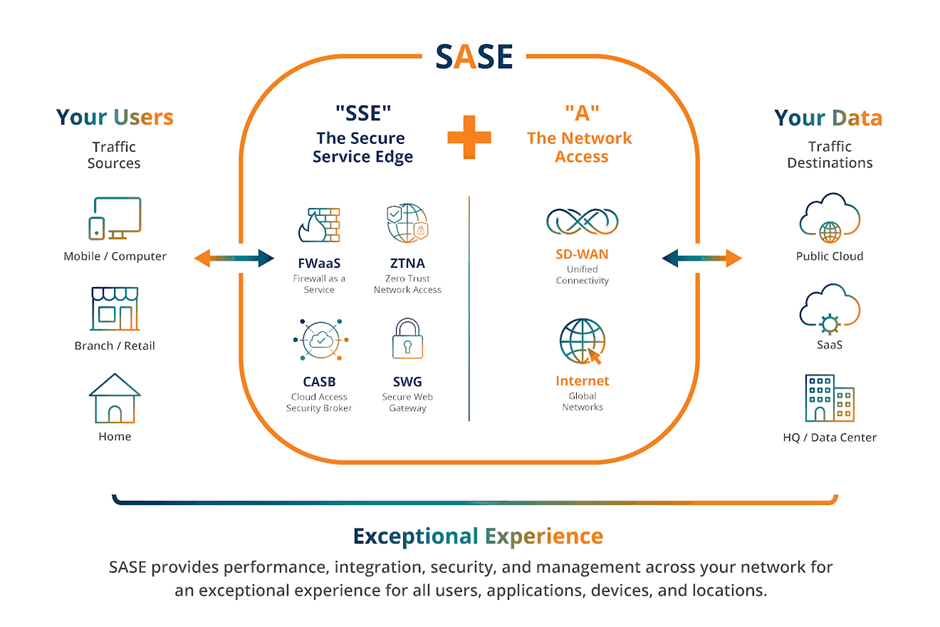
Keynote Summary: SASE (Secure Access Service Edge) converges network and security into a single, cloud-native architecture. It combines SD-WAN with security functions – secure web gateways, CASB, zero trust network access, and firewall capabilities – into one cloud-delivered service. For enterprises managing remote users, SaaS, and multi-cloud deployments, SASE eliminates the architectural strain of routing all traffic back to a central data center.
FAQs:
What does SASE stand for?
Secure Access Service Edge – a cloud-native framework that unifies networking and security into one managed service.
What are the core components of SASE?
SD-WAN, secure web gateway (SWG), cloud access security broker (CASB), zero trust network access (ZTNA), and firewall-as-a-service (FWaaS).
Why does SASE matter for multi-cloud?
Multi-cloud environments have traffic flowing in many directions – SASE ensures security policy travels with the user and data, not the network perimeter.
How is SASE different from traditional network security?
Traditional security depends on routing traffic through a central data center; SASE enforces security at the edge, closer to where users and data actually are.
Is SASE the same as zero trust?
Zero trust is a principle (never trust, always verify); SASE is an architecture that can implement zero trust as part of its access model.