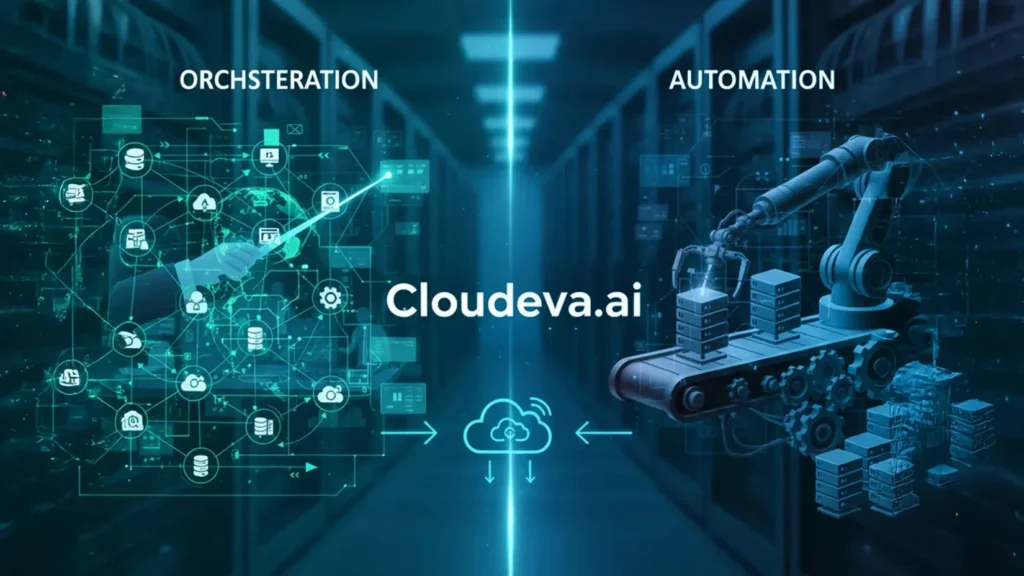
Automation is no longer just about replacing manual tasks. Today, automation is reshaping business, industries, manufacturing, enterprise operations, and even how human workers interact with technology. From industrial automation and business process automation to cloud automation, the world is seeing increased automation across systems, processes, and operations.
As a writer observing this shift closely, one truth stands out; automation ensures speed, but orchestration ensures intelligence. And that is exactly the transformation Cloudeva.ai is driving in modern cloud ops.
Writer’s View: Automation, Humans, and the New Reality of Work
Research shows that the introduction of industrial robots reduced employment of men by 3.7% and women by 1.6%. Studies also indicate that wages and educational attainment are strongly negatively correlated with an occupation’s risk of being automated. By 2030, between 3% and 14% of the global workforce will be forced to switch job categories.
Yet automation does not remove human capabilities – it reshapes them. What it truly removes are repetitive tasks, dangerous mechanical work, and low-value activities. What it creates are opportunities for decision making, innovation, and strategic development.
Automation: The Foundation of Digital, Industrial, and Business Transformation
Automation is the application of technology to perform tasks with reduced human intervention. It is used to automate workflows, automate systems, and automate processes across nearly every sector.
Automation today:
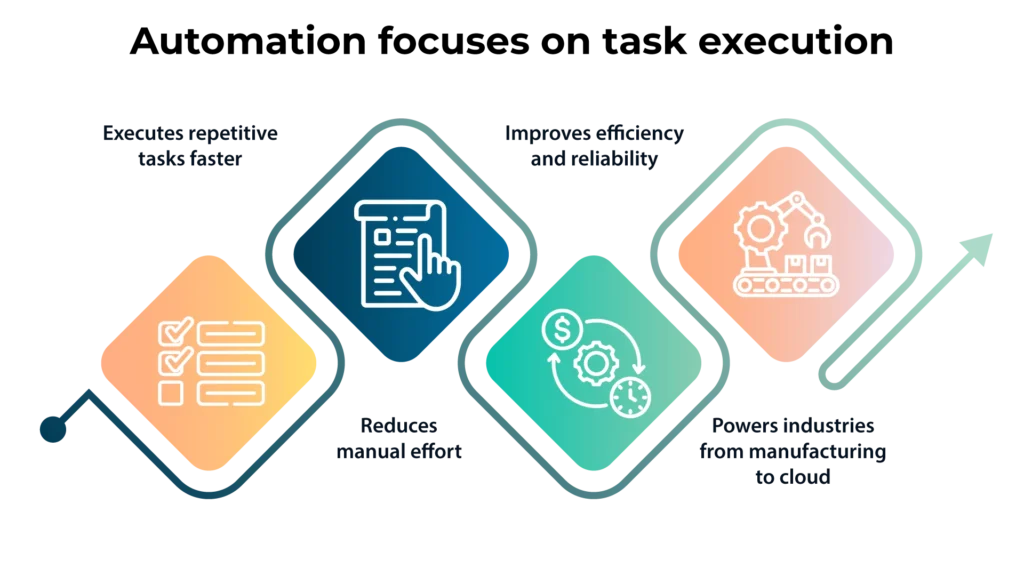
- Handles repetitive tasks faster than humans
- Reduces human labor
- Improves system performance
- Enhances productivity, efficiency, and reliability
- Drives digital transformation
From building automation and home automation to cloud automation, automation now powers business functions, services, operations, and enterprise control systems.
Industrial automation: The Backbone of Modern Manufacturing Processes
Industrial automation focuses on manufacturing processes, quality control, and material handling. Robots now perform hazardous work such as automobile spray painting and welding, improving safety, precision, and efficiency.
Companies like Tesla, Amazon, and General Motors use extensive automation and robotics to accelerate production, improve control, and boost productivity. The introduction of automation in factories has historically led to massive productivity gains and stronger quality assurance systems.
Industrial automation also relies on:
- Sensors
- Mechanical systems
- Control programs
- Telemetry and communications
- Computer systems
Business Process Automation: Driving Uniformity, Control, and Transparency
Business Process Automation (BPA) focuses on automating business process workflows across departments. It helps organizations:
- Improve service delivery
- Reduce costs
- Increase productivity
- Improve system reliability
- Strengthen process control
However, a critical insight remains true:
Automating an inefficient or broken process only makes the problem faster and harder to fix.
That’s where orchestration becomes essential.
Business Process: Why Orchestration Is the Missing Intelligence Layer
A business process may include approvals, audits, incident response, billing, onboarding, FinOps, and SecOps. Individually automated, these become complex processes to manage.
Orchestration connects all automated tasks into one intelligent operational fabric—across systems, tools, data, security, and workflows.
Business Automation: From Task Execution to Autonomous Decision Making
Traditional business automation executes tasks. Modern automation is about:
- Decision making
- Risk mitigation
- Predictive actions
- Smart deployment
Through AI, machine learning, and cognitive automation, organizations now automate not just tasks – but thinking layers of operations.
Automation Technologies: From Robotics to Cognitive Automation
Automation involves a very broad range of automation technologies, including:
- Robotics
- Expert systems
- Process measurement and control
- Telemetry and communications
- AI assistants
- Machine learning
- Natural language processing
Cognitive automation structures unstructured data, automating compliance reviews, claims processing, and customer service. These software robots are now central to finance, banking, and IT automation.
Computer Systems & Automation Software: The Intelligence Engine
Modern automation software connects:
- Computer systems
- APIs
- Applications
- Devices
- Data pipelines
This seamless integration ensures higher system performance, better security, and faster deployment across cloud and enterprise environments.
Human workers, human intervention & human capabilities:
What Automation Truly Replaces
Automation reduces human intervention, not human value. It removes:
- Manual tasks
- High-risk mechanical work
- Low-efficiency operations
It enhances:
- Human capabilities
- Creative work
- Strategic leadership
- Business decision making
New-Gen Automation: Real-World Examples Across Industries
Retail: Self-checkout kiosks automate transactions
Healthcare: The da Vinci Surgical System enables minimally invasive robotic surgery
Agriculture: Autonomous tractors, drones with GPS and sensors automate planting and harvesting
Transportation: AGVs and AMRs enhance efficiency and safety
Finance: RPA and AI automate fraud detection, transactions, and customer service
Energy & Utilities: Automated systems manage power grids and optimize distribution
This is such automation at global scale.
Cloud automation: Where Orchestration Becomes Mission-Critical
Cloud automation automates:
- Infrastructure provisioning
- Security responses
- Cost optimization
- Compliance enforcement
- Incident management
But without orchestration, cloud operations become fragmented across:
1. Tools
2. Teams
3. Vendors
4. Environments
This is exactly where Cloudeva.ai changes the game.
Automation tools & Automation department: Why Teams Get Stuck
Most automation teams rely on multiple automation tools across security, finance, DevOps, and compliance. Without a centralized orchestration layer:
- Visibility fragments
- Data silos emerge
- Workflows break
- Operations slow down
A unified orchestration platform becomes essential.
Automation community: The Talent and Workforce Shift
The automation community now includes:
- Robotics engineers
- AI architects
- Cloud automation engineers
- SecOps analysts
- FinOps specialists
Yet anxiety remains high. Opinion polls show automation fear strongly correlates with the strength of organized labor in a region. This reflects deep economic shifts tied to income polarization – high-skill jobs rising, middle-wage jobs shrinking.
Manufacturing processes & Manufacturing: Still the Automation Powerhouse
Industrial automation remains crucial to manufacturing processes, improving:
- Output precision
- Quality control
- Machine reliability
- Operational safety
Robotics now dominate hazardous applications like welding and spray painting, creating safer factory environments.
Repetitive Tasks, Manual Tasks & Perform Tasks:
Where Automation Wins Instantly
Automation handles repetitive tasks and manual tasks far faster than humans. It can perform tasks continuously, without fatigue, with higher accuracy and lower costs.
This enables employees to focus on:
- Strategy
- Innovation
- Business growth
- Customer experience
Seamless Integration, Systems & Workflows:
Orchestration in Action
True orchestration enables:
- Seamless integration across systems
- Unified workflows
- Predictive alerts
- Automated responses
- End-to-end operational intelligence
Technological advances & Increased automation:
The Acceleration Era
Technological advances in AI, cloud computing, sensors, and robotics are driving increased automation across:
- Enterprises
- Governments
- Education
- Healthcare
- Finance
- Manufacturing
Challenges, Costs, Risk & Security: The Hard Truth About Automation
- Automation also introduces:
- High costs (software, hardware, training)
- Integration challenges
- Cybersecurity risks
- Employee resistance
- Job displacement
Data security concerns now require advanced cybersecurity measures to protect automated systems and sensitive enterprise data.
Solutions, Benefits & Improve Efficiency: Why Businesses Still Choose Automation
Despite challenges, organizations adopt automation because the benefits are undeniable:
- Improve efficiency
- Increase productivity
- Reduce errors
- Contain costs
- Improve customer satisfaction
- Strengthen business performance
Automation provides benefits to virtually all industries.
What Cloudeva.ai Brings to Modern Cloud Ops
Cloudeva.ai elevates automation into full-scale orchestration across cloud environments:
- AI-native cloud automation
- Conversational cloud operations
- AI-diven FinOps & SecOps
- Multi-cloud discovery
- Predictive analytics
- Unified control across workflows and systems
- Agentic AI roadmap for autonomous operations
It connects automation, data, security, workflows, and intelligence into one orchestration fabric.
Final Writer’s Note
Automation has already changed factories, hospitals, farms, banks, and homes. Now, it is transforming cloud operations. But the real future belongs to those who move from:
Automated tasks → Orchestrated systems → Autonomous operations
And Cloudeva.ai is building exactly that future.
Keynote Summary: Automation ensures speed; orchestration ensures intelligence. Automation handles individual tasks; orchestration coordinates multi-step processes across systems with context and decision logic. Cloudeva.ai sits at the orchestration layer for cloud ops – not just triggering actions but coordinating Explain → Verify → Advise workflows that keep humans in the decision seat while eliminating repetitive triage work.
FAQs:
What is the difference between automation and orchestration?
Automation executes single, repetitive tasks; orchestration coordinates multiple tasks across systems with logic and sequencing.
Why is orchestration more powerful for cloud ops?
Cloud environments are too complex for task-level automation alone – orchestration maintains context, handles dependencies, and routes decisions correctly.
What does Cloudeva.ai bring to cloud orchestration?
It layers intelligence over cloud signals – correlating events, contextualizing changes, and guiding human decisions rather than just triggering scripts.
Will automation eliminate cloud engineering jobs?
No – it eliminates repetitive triage and low-value tasks, freeing engineers for decision-making and strategic architecture.
What is the EVA model’s role in orchestration?
Explain → Verify → Advise creates an orchestrated decision workflow that keeps humans informed and in control at each stage.