
Cloud-native systems are no longer confined to centralized data centers. Modern cloud computing architectures now span public regions, edge locations, on-premises systems, and hybrid deployments. This shift fundamentally changes how cloud security must be designed, operated, and governed. Extending security operations to the edge is no longer optional: it is foundational to resilience, compliance, and business continuity.
Cloud computing security is a comprehensive framework that includes policies, technologies, and controls designed to safeguard data, applications, and infrastructure in cloud environments. This framework also emphasizes the shared responsibility model implemented by cloud service providers to ensure security across different service models such as IaaS, PaaS, and SaaS, as well as emerging shared fate approaches for enhanced security collaboration.
Writer’s Note: Cloud security is a discipline of cyber security dedicated to securing cloud computing systems. As organizations distribute workloads closer to users and devices, the security of cloud computing depends on consistent controls, real-time visibility, and coordinated response across highly decentralized cloud environments.
Data protection is a critical aspect of cloud computing security, with cloud providers implementing measures like encryption, access controls, and compliance with legal regulations (such as GDPR and HIPAA) to safeguard data throughout its lifecycle and ensure privacy.
Cloud security is increasingly important as more companies move to the cloud from on-premises environments, especially with data governance and compliance under the regulatory microscope.
Security of Cloud Computing in Distributed Architectures
The security of cloud computing encompasses policies, controls, technologies, and processes designed to protect applications, workloads, and cloud data regardless of where they run. In distributed architectures, the attack surface expands dramatically due to edge nodes, APIs, third-party integrations, and direct internet exposure.
This increased attack surface introduces additional security vulnerabilities, making it crucial to address potential threats and weaknesses to protect cloud applications, data, and infrastructure.
Cloud computing has become the technology of choice for companies seeking agility and faster innovation. However, as adoption accelerates, cloud security risks also rise – particularly misconfigurations, weak access management, and inconsistent security measures across environments. Organizations face significant cloud security challenges, including misconfigurations, weak access controls, data breaches, insecure APIs, insider threats, and compliance issues.
Writer’s Note: To mitigate these risks and challenges, it is essential to implement comprehensive security practices, such as encryption, configuration management, and proactive security measures, within cloud security frameworks.
What Is Cloud Security?
Cloud Security Defined
Cloud security refers to the cybersecurity policies, best practices, controls, and technologies used to secure applications, data, and infrastructure in cloud environments. Cloud security is the set of cybersecurity measures used to protect cloud-based applications, data, and infrastructure.
Why Cloud Security Is Important
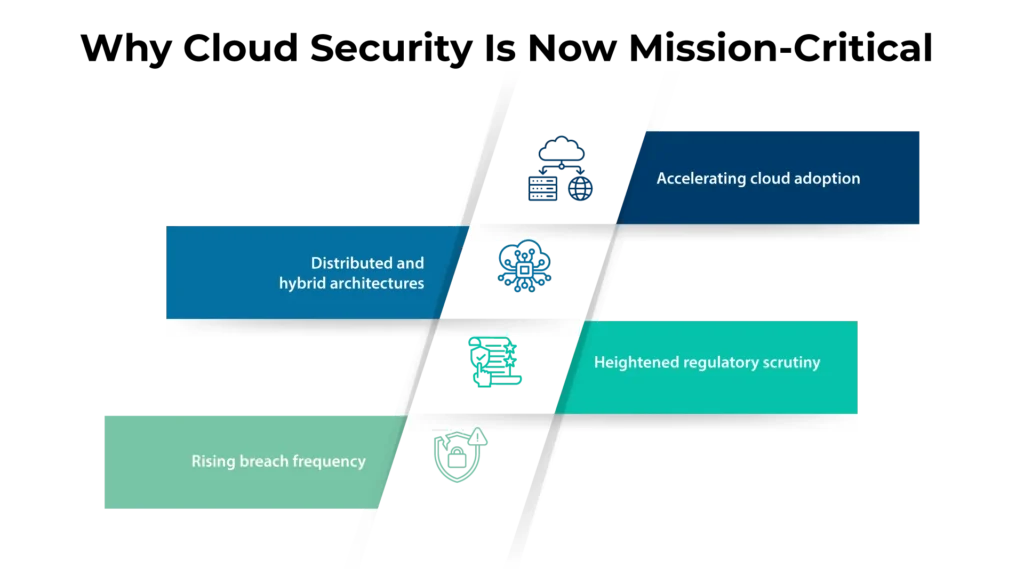
Cloud security is important as more organizations move from on-premises systems to public cloud environments, private cloud, and hybrid cloud models. Regulatory scrutiny, rising data breaches, and increased reliance on cloud services make cloud security important regardless of enterprise size.
Writer’s note: Industry metrics consistently show that misconfigurations account for approximately 31% of cloud data breaches, largely driven by human error and lack of continuous monitoring.
Data Security in Cloud Computing Environments
Protecting Sensitive and Critical Data
Data security focuses on safeguarding sensitive data and critical data across storage, processing, and transmission. Encryption remains one of the most effective security techniques, protecting data at rest and in transit.
Data Loss and Breach Prevention
Data loss remains a top concern in distributed cloud computing environments. Data loss prevention (DLP) services help prevent unauthorized data access, exfiltration, and accidental exposure. Studies show automated bots can discover misconfigured resources within minutes of deployment, emphasizing the need for real-time enforcement.
Cloud Security Risks at the Edge
Expanding Attack Surfaces
Edge deployments increase exposure through APIs, unmanaged devices, and reliance on internet connectivity. Security threats now include vulnerable APIs, insider misuse, ransomware, and AI-powered phishing campaigns.
Misconfigurations and Inadvertent Insiders
Misconfigured cloud infrastructure remains a leading cause of cloud data breaches. A substantial portion of breached records can be attributed to misconfigured assets, making inadvertent insiders a dominant risk vector in modern cloud environments.
Cloud Security Concerns Across Providers
Organizations increasingly rely on multiple cloud computing providers, complicating policy enforcement and visibility. Operating across more than one cloud provider introduces fragmented tooling, inconsistent logging, and delayed incident response.
The shared responsibility model defines how cloud service providers secure underlying infrastructure while customers remain responsible for securing applications, identities, and data. Misunderstanding this division continues to be a root cause of security incidents.
Cloud Security Refers to Shared Responsibility
Understanding the Shared Responsibility Model
In the shared responsibility model, cloud service providers are responsible for securing physical data centers, public cloud servers, and foundational services. Customers must secure workloads, user access, configurations, and data storage.
Why It Matters
Understanding the shared responsibility model is critical for building a resilient security strategy. Misaligned assumptions frequently result in compliance gaps, delayed threat response, and increased exposure to regulatory penalties.
Security Operations in Distributed Cloud Environments
Security operations extend beyond alert handling. In distributed systems, security operations must coordinate visibility, event management, and response across edge, cloud, and on-prem systems.
Security information is collected and analysed by Security Information and Event Management (SIEM) systems, which play a critical role in threat monitoring, detection, and response across distributed cloud environments.
High-performing organizations integrate telemetry from operating systems, APIs, and physical network components to maintain situational awareness. Without this integration, blind spots grow as environments scale.
Security Operations SecOps Explained
What Does SecOps Mean?
Security operations SecOps aligns security and operations teams to embed protection into daily workflows. Unlike reactive models, SecOps emphasizes automation, threat detection, and proactive remediation.
SecOps vs DevOps
SecOps focuses on risk reduction and resilience, while DevOps prioritizes speed and delivery. Mature organizations integrate both, embedding security controls throughout the software development lifecycle.
Security Operations Center for the Edge
A modern security operations center must support distributed telemetry and 24/7 monitoring. Centralized SOC models struggle when edge nodes generate high-volume, low-latency security events.
Writer’s Note: Metrics show organizations with integrated SOC visibility reduce mean time to detect incidents by up to 40%, significantly improving business continuity outcomes.
Threat Intelligence in Cloud Security
Why Threat Intelligence Matters
Threat intelligence contextualizes raw alerts by correlating indicators across environments. In cloud-native systems, intelligence-driven prioritization helps security teams focus on exploitable risks rather than noise.
AI-Driven Threat Intelligence
Attackers increasingly use AI for autonomous reconnaissance and deepfake impersonation. Defensive threat intelligence platforms now leverage machine learning to anticipate emerging cyber threats.
Continuous Monitoring as a Security Requirement
Continuous monitoring is essential for identifying misconfigurations, suspicious behaviour, and compliance drift. In distributed architectures, delayed visibility often means delayed containment.
Writer’s Note: Organizations that implement real-time monitoring report up to 60% faster threat detection compared to periodic audits alone.
Threat Detection and Threat Response at Scale
Advanced Threat Detection
Modern cloud security solutions integrate behavioural analytics to identify anomalies across cloud assets. Threat detection now extends beyond signatures to include identity misuse and lateral movement.
Coordinated Threat Response
Effective threat response requires automation. Manual processes cannot keep pace with automated attacks that exploit vulnerabilities within minutes of exposure.
Disaster Recovery and Business Continuity
Disaster recovery is a core pillar of cloud security. Multi-layered, immutable backups across geographically separated locations are essential for resilience against ransomware and insider attacks.
Writer’s Note: Organizations with tested recovery plans restore services up to 70% faster, significantly improving business continuity during incidents.
Identity and Access Management at the Edge
Identity and access management governs who can access what, when, and from where. Edge deployments amplify challenges due to non-human identities such as service accounts and API tokens, which often outnumber human users.
Strong access management, least-privilege enforcement, and continuous identity monitoring are critical to maintaining a secure cloud environment.
Network Security and Physical Network Considerations
While cloud abstracts infrastructure, network security and physical network protections remain relevant. Secure connectivity, segmentation, and encrypted tunnels, sometimes including virtual private networks help protect distributed workloads.
Cloud Security Architecture for Distributed Systems
A resilient cloud security architecture integrates security layers across compute, identity, data, and network domains. Architecture is only effective if defensive implementations are correctly configured and continuously validated.
Compliance, Governance, and Regulatory Pressure
Global regulations such as data sovereignty laws and the EU AI Act increase compliance complexity. Legal compliance in cloud security revolves around protecting user privacy and managing jurisdictional risk.
Organizations that rely solely on third-party controls often face governance gaps, particularly in multi cloud environments.
Security Solutions for Distributed Cloud Operations
Modern security solutions combine CSP-native controls with platform-level orchestration. Cloud security solutions commonly include cloud security posture management, IAM, DLP, and automated remediation.
CSPM tools help identify misconfigurations and enforce compliance, reducing exposure from configuration drift across environments.
Cloud Security Work in Practice
How cloud security work happens matters as much as tooling. Effective programs integrate security tasks, standardized security processes, and role-based accountability.
Organizations that operationalize security report fewer security incidents and faster recovery times.
Addressing Human Error and Insider Risk
Human error remains unavoidable. Security awareness training, automated guardrails, and just-in-time access reduce the impact of mistakes.
Insider threats both malicious and accidental continue to rank among the top risks in cloud computing environments.
Secure Cloud Environment Design Principles
A secure cloud environment is built on Zero Trust principles: never trust, always verify. Continuous validation of identities, devices, and workloads minimizes lateral movement during breaches.
Future-Proofing Cloud Security Strategy
High-maturity organizations are exploring post-quantum cryptography and AI-assisted remediation. As attackers automate faster, defenders must do the same to protect computing resources at scale.
Security Solutions as a Strategic Enabler
Cloud security benefits include centralized management, reduced costs compared to on-prem models, and faster innovation. When designed correctly, security becomes an enabler, not a bottleneck – for distributed architectures.
Conclusion
Extending SecOps to the edge is a strategic imperative. Distributed architectures amplify both opportunity and risk. Organizations that invest in continuous monitoring, intelligence-driven security operations, and automated threat response are best positioned to protect data, maintain compliance, and ensure resilience in the evolving cloud landscape.
Cloud security is no longer a perimeter problem, it is an operational discipline that defines trust, availability, and long-term business value.
Extend SecOps Beyond the Core with Cloudeva.ai
Unify security operations across cloud, edge, and hybrid environments with AI-driven visibility, continuous monitoring, and automated threat response. See how Cloudeva.ai operationalizes SecOps to reduce risk, close misconfiguration gaps, and strengthen your security posture at scale.