Introduction: Why the Data Cloud Matters in 2026
In 2025, organizations no longer struggle with a lack of data – they struggle with fragmented data. Business data is spread across cloud services, CRM platforms, mobile apps, marketing systems, and external platforms. The challenge today is unifying this data into a single, intelligent system.
By 2026, this challenge intensifies. Enterprises are expected to manage exponentially growing data volumes, real-time data streams, and AI-driven workloads simultaneously. Without a unified data foundation, organizations risk slower decision-making, rising operational costs, and missed opportunities for personalization and automation.
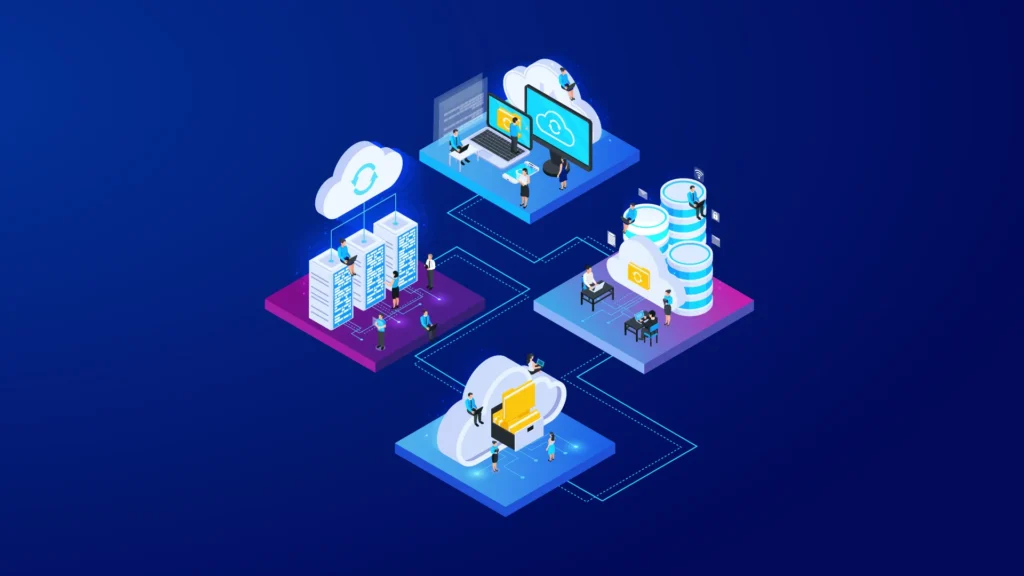
A data cloud addresses this challenge by acting as a centralized data platform that connects enterprise data, customer data, and external data into one trusted source.
Informative Metric:
Organizations using a data cloud experience up to 35% faster decision-making due to unified customer profiles and real time data access.
What Is the Data Cloud?
A data cloud is a centralized, scalable platform that connects and unifies business data from across the organization and beyond. It enables real time data access, analytics, and collaboration without duplicating or moving data.
A data cloud eliminates silos and provides a single, trusted view of customers and operations.
How Data Clouds Work in a Multi-Cloud Environment
Modern enterprises rely on multiple cloud services and cloud infrastructure providers such as Google Cloud. This creates complexity in data access, data sharing, and cost management.
A data cloud sits above cloud data environments and unifies data across platforms while maintaining governance and security.
Core Capabilities of a Data Cloud
A data cloud provides centralized storage, seamless data integration, and advanced analytics capabilities. It enables users to prepare, transform, and analyze data efficiently within a unified environment, supporting better decision-making and operational agility.
Data clouds can support various industries, including healthcare, retail, and financial services, by providing tailored solutions.
Key Capabilities of a Modern Data Cloud
- Real time data access across multiple data sources
- Identity resolution for unified customer profiles
- Zero copy architecture to reduce duplication
- Native support for machine learning and artificial intelligence
- Built-in access controls and data privacy
These data cloud capabilities enable users to activate trusted data at scale.
Data Models, Data Lakes, and Data Warehouses
Understanding Data Cloud Architecture
A data cloud brings together data from multiple sources, enabling organizations to unify, analyze, and act on their data in real time. It integrates data models, data lakes, and data warehouses to provide a comprehensive view of business information.
Data storage is a key consideration in data cloud architecture. Salesforce Data Cloud is built on Apache Iceberg, which reduces data storage costs and allows for more efficient data access.
By leveraging a data cloud, businesses can break down data silos, improve data governance, and accelerate digital transformation.
Understanding Data Models in a Data Cloud
Data models define how data types relate to one another. In Salesforce Data Cloud, Data Model Objects (DMOs) are used to structure and relate data entities, similar to how standard and custom Salesforce objects are used in Salesforce to organize and manage data. Standard objects are predefined, structured entities within the Salesforce data model, serving as a canonical data model with set attributes, while custom objects allow for tailored data structures.
Salesforce Data Cloud collects multiple data points from various sources, which are then modeled and segmented for marketing and customer engagement purposes.
Data Model Objects (DMOs) provide a virtual, non-materialized view into the data lake, allowing for dynamic querying without storing results.
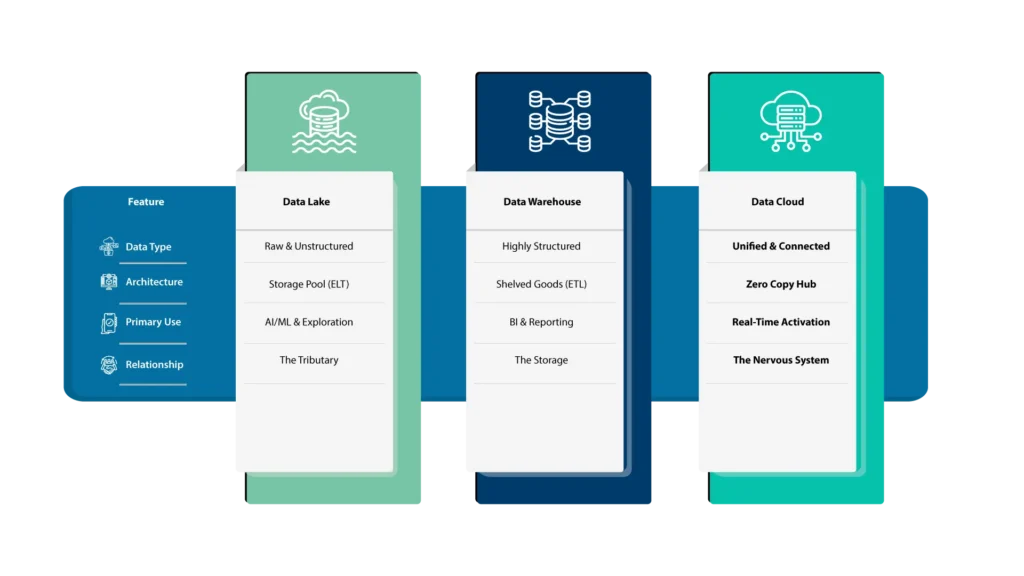
Data Lake vs Data Warehouse in a Data Cloud
- A data lake stores raw and unstructured data
- A data warehouse organizes structured data for analytics
- A data cloud connects both without duplicating data
Data clouds can query the underlying data in data warehouses and data lakes, providing direct access for analytics and integration. Bring Your Own Data Lake (BYOL) Federation allows Salesforce Data Cloud to virtualize warehouse data, enabling queries against the underlying data in the warehouse.
Zero Copy Architecture and Data Sharing
Zero copy architecture is transforming the way organizations manage and utilize their data cloud environments. Data clouds enable organizations to share data seamlessly between platforms, supporting bi-directional data movement and integration across Salesforce applications, data warehouses, and other sources. Data 360 connects directly to platforms like Snowflake and Databricks using Zero-Copy integrations, allowing data to be used without duplication. This approach eliminates the need for multiple data copies, reducing storage costs and improving data consistency.
How Zero Copy Architecture Works
Zero copy integration allows querying Salesforce data directly from a data warehouse without storing a physical copy. Platforms like Snowflake and Databricks use zero copy architecture.
Benefits include:
- Faster analytics
- Cost savings
- Improved data quality
- Reduced data duplication
Data Streams, Data Sources, and Data Ingestion
What Are Data Streams?
Data streams define how data flows from data sources into the data cloud. Each data stream supports real time data access and can ingest data from internal systems and external data sources.
Customer Data and Unified Profiles
Identity Resolution and Unified Customer Profiles
Identity resolution stitches together customer data from multiple systems into unified customer profiles. This enables:
- Better audience segments
- Stronger customer relationships
- Improved customer satisfaction
Salesforce Data Cloud creates unified profiles across sales cloud, service cloud, and marketing cloud.
Informative Metric:
Businesses using unified profiles see 25% higher campaign conversion rates.
Security, Governance, and Data Privacy
Data clouds include built-in governance, access controls, and encryption to protect sensitive data and sensitive information. Automated governance tools help organizations comply with global regulations such as GDPR and HIPAA.
Cloud Computing and the Four Types of Cloud Services
Understanding Data Cloud and Its Importance
Cloud computing has revolutionized the way businesses store, manage, and analyze data. With the rise of data cloud solutions, organizations can now leverage scalable infrastructure, advanced analytics, and seamless integration to drive innovation and efficiency.
The Four Cloud Service Models Explained
- Infrastructure as a Service (IaaS)
- Platform as a Service (PaaS)
- Software as a Service (SaaS)
- Data Platform as a Service (DPaaS)
A data cloud operates as a data platform across all four models, reducing vendor lock in.
Artificial Intelligence and Machine Learning in the Data Cloud
Data clouds provide clean, standardized data required to train machine learning models and power artificial intelligence. Salesforce Data Cloud supports natural language queries, calculated insights, and actionable insights.
Industry Use Cases for Data Clouds
Healthcare, Retail, and Financial Services
- Healthcare: Health Cloud enables secure patient data access
- Retail: Real time personalization using audience segments
- Financial Services: Secure data sharing and compliance
Cost Management and Business Value
Using a pay-as-you-go model, data clouds shift capital expenditure to operational expenditure, delivering measurable cost savings and improved operational efficiency.
Future Trends in Data Clouds
Future data clouds will focus on real time data processing, enhanced data security, and deeper integration with artificial intelligence tools.
Conclusion: Turning Data into a Strategic Asset
A data cloud transforms fragmented data into a unified, intelligent, and actionable resource. Platforms like Salesforce Data Cloud empower businesses to unify data, activate insights, and build resilient multi-cloud strategies.
Bring Clarity to Your Multi-Cloud Data with Cloudeva.ai
Managing data across multiple cloud services doesn’t have to mean complexity, blind spots, or rising costs. Cloudeva.ai helps organizations gain a unified view of their multi-cloud infrastructure, enabling smarter cost management, stronger governance, and faster operational decisions.
With AI-native insights, predictive analytics, and conversational cloud operations, Cloudeva.ai empowers teams to monitor cloud data, optimize resources, and maintain compliance – without switching tools or adding operational overhead.
Discover how Cloudeva.ai turns multi-cloud complexity into clarity. Book a demo today!
Keynote Summary: Data fragmentation is the defining challenge of 2026 – business data is spread across cloud services, CRMs, mobile apps, and marketing systems. A data cloud unifies this into a centralized, trusted platform that connects enterprise data, customer data, and external sources without duplicating or moving data. Organizations using a data cloud see up to 35% faster decision-making from unified real-time access.
FAQs:
What is a data cloud?
A centralized, scalable platform that connects and unifies data from across an organization – eliminating silos and providing a single trusted view.
How is a data cloud different from a data warehouse?
A data warehouse stores structured historical data for reporting; a data cloud connects live data from multiple sources for real-time access and sharing.
What is data fragmentation?
Business data distributed across disconnected tools and systems – preventing unified analysis, slowing decisions, and increasing operational cost.
Which industries benefit most from a data cloud?
Any data-intensive industry: retail, BFSI (banking, financial services and insurance), healthcare, and logistics where real-time customer or operational data is critical.
How does a data cloud support AI workloads?
By providing clean, unified, real-time data that AI models can access without complex ETL pipelines or data duplication.