Cloud orchestration has become the cornerstone of modern IT infrastructure, enabling organizations to manage complex workflows across diverse cloud environments with surgical precision. Orchestration in cloud computing coordinates multiple automated tasks across cloud platforms, transforming chaotic manual processes into intelligent, self-optimizing systems.
As enterprises embrace multi cloud architectures spanning multiple cloud platforms, cloud orchestration emerges as the essential capability delivering speed, efficiency, and scalability.
Automation Tools in Modern Cloud Computing
Automation tools form the foundation of cloud automation, handling individual tasks like server provisioning, auto-scaling, and basic monitoring. These tools excel at automating repetitive tasks and routine tasks, eliminating manual intervention for discrete operations across cloud infrastructure.
When integrated with cloud orchestration platforms, automation tools become exponentially more powerful. Cloud automation manages cloud resources like virtual machines and storage independently, while cloud orchestration coordinates these automation tools into sophisticated orchestration workflows that span multiple cloud services.
Cloud Management Across Cloud Environments
Cloud management requires comprehensive visibility across cloud platforms, intelligent resource allocation, and continuous optimization to control cloud spending. Effective cloud management spans public cloud providers, private and public clouds, and hybrid cloud environments, demanding unified control across diverse cloud infrastructure.
Cloud management platforms integrate cloud orchestration to provide centralized dashboards, cost analytics, compliance monitoring, and automated remediation. This unified approach transforms fragmented cloud operations into cohesive business processes, enabling IT teams to focus on strategic outcomes rather than tactical firefighting.
Cloud Computing Orchestration Fundamentals
Cloud computing orchestration represents the intelligent coordination of multiple cloud services into unified automation processes. Unlike basic cloud automation that handles individual tasks, cloud computing orchestration understands dependencies, sequences operations correctly, and manages error recovery across distributed cloud environments.
A cloud orchestration solution automates and coordinates complex deployment, configuration, and management tasks across cloud environments. However, implementing cloud orchestration solutions can be challenging due to the rapid evolution of tools, which may lead to skill gaps among IT staff.
Cloud Orchestration Benefits Quantified
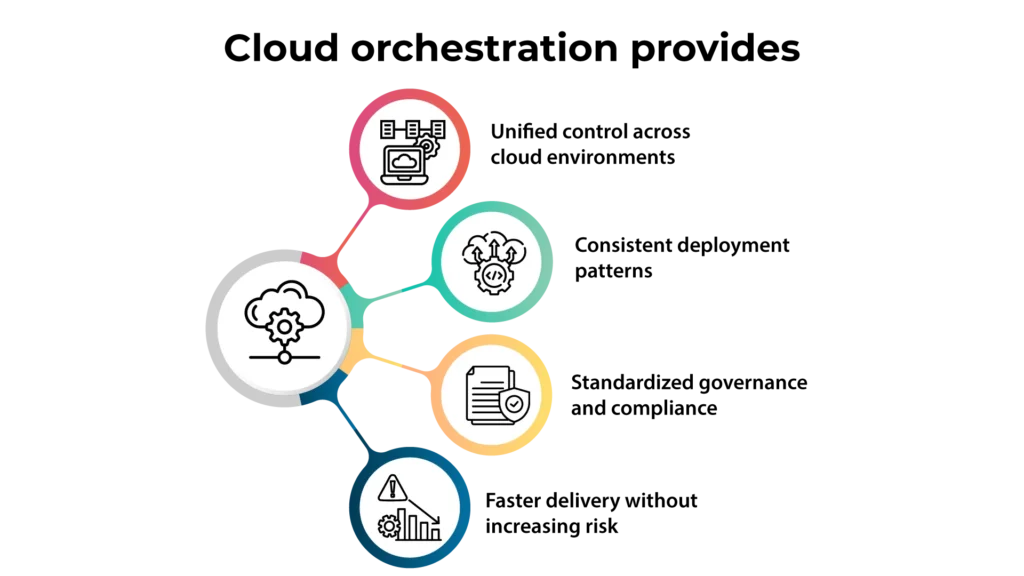
Cloud orchestration benefits deliver measurable ROI across multiple dimensions. Complex deployments complete 70% faster through workflow automation, eliminating manual intervention and ensuring consistent outcomes across cloud environments. Operational efficiency improves dramatically as routine tasks become autonomous.
Additional cloud orchestration benefits include 25-35% cost optimization through intelligent right-sizing, 30-50% improvements in resource utilization, and enhanced security protocols embedded automatically in every workflow. These advantages compound as cloud orchestration scales to handle increasingly complex IT environments.
Benefits of Cloud Orchestration Deep Dive
Benefits of cloud orchestration extend beyond speed to include comprehensive infrastructure management. By automating entire workflows, organizations achieve audit-ready deployments that meet regulatory requirements across hybrid cloud environments and multi cloud deployments.
Benefits of cloud orchestration also encompass disaster recovery automation, compliance enforcement through policy-as-code, and predictive capacity planning. These capabilities transform cloud infrastructure from cost centers into strategic assets delivering sustainable competitive advantage.
Benefits of Cloud Computing Advantages
Benefits of cloud computing include elastic scalability, pay-as-you-go economics, and global availability through cloud services. Organizations gain agility without massive upfront capital expenditures on computing infrastructure, accessing enterprise-grade capabilities instantly.
Benefits of cloud extend to built-in disaster recovery, collaboration platforms, machine learning services, and security expertise from cloud providers. These advantages drive innovation across industries while cloud orchestration ensures optimal utilization of these distributed cloud resources.
Cloud Orchestration Models Compared
Cloud orchestration models vary by organizational maturity and requirements. Managed orchestration service platforms like AWS Step Functions and Google Cloud Workflows handle underlying infrastructure, ideal for rapid adoption with minimal operational overhead.
Self-managed cloud orchestration models like Kubernetes and Terraform offer maximum control for advanced IT teams.
Introduction to Cloud Computing Infrastructure
Cloud computing revolutionized how organizations access cloud resources, servers, storage, databases, networking, delivered over the internet. This on-demand model enables rapid scaling, cost optimization, and adaptability to changing business processes.
As cloud computing adoption accelerates, coordinating these distributed cloud resources becomes mission-critical. Cloud orchestration emerges as the intelligent layer managing cloud infrastructure, cloud services, and automation processes across cloud platforms.
Defining Cloud Orchestration Core Principles
Cloud orchestration systematically coordinates cloud services, cloud resources, and automation tools across cloud platforms. Orchestration in cloud computing automates complex workflows that span multiple cloud services, ensuring consistency regardless of underlying infrastructure diversity.
Cloud orchestration platforms like Kubernetes, Terraform, and cloud orchestration tools provide the technological foundation. Infrastructure as code (IaC) and infrastructure as code practices enable reproducible deployments that cloud orchestration can scale dynamically across cloud environments.
Cloud Orchestration vs Cloud Automation
Cloud orchestration vs cloud automation represents a critical distinction. Cloud automation excels at automated tasks like provisioning a web server or scaling databases. Cloud orchestration coordinates multiple automated tasks into cohesive workflow automation across cloud infrastructure.
In hybrid cloud environments, cloud orchestration vs basic automation tools becomes starkly apparent. Orchestration tools manage dependencies across multiple cloud services, while simple automation struggles with complex workflows requiring intelligent sequencing and recovery.
Essential Components of Cloud Orchestration Platforms
Cloud infrastructure forms the foundation that cloud orchestration platforms manage intelligently. Cloud resources including compute instances, storage volumes, networking constructs, and security protocols require continuous coordination across dynamic cloud environments.
Key features of effective cloud orchestration solutions include declarative workflow definitions, real-time monitoring tools, seamless integration with configuration management tools, and robust infrastructure as code support. These capabilities enable scaling from simple provisioning to enterprise-grade complex IT environments.
Top Cloud Orchestration Tools for 2026
Leading cloud orchestration tools include Kubernetes for container orchestration, Terraform for infrastructure as code (IaC), Ansible Automation Platform, and IBM Cloud Orchestrator. Orchestration tools have matured to support enterprise-scale multi cloud orchestration.
Kubernetes auto-scales thousands of containers across AWS, Azure, and Google Cloud. Terraform provisions cloud resources across different cloud platforms declaratively. IBM Cloud Orchestrator delivers managed orchestration service spanning private and public clouds.
Multi Cloud Orchestration Strategies
Multi cloud adoption reached 89% of enterprises in 2026, demanding sophisticated multi cloud orchestration. Multi cloud orchestration addresses coordination challenges across AWS, Azure, Google Cloud, and private cloud infrastructure through provider-agnostic abstractions.
Multi cloud model benefits include avoiding vendor lock-in, leveraging best-of-breed public cloud providers, and achieving cost optimization through workload portability. Cloud orchestration standardizes operations across multiple cloud platforms, enabling cloud strategies that maximize business value.
Container Orchestration with Kubernetes
Container orchestration via Kubernetes represents the gold standard for modern application deployment. Container orchestration automates deployment, scaling, and management of containerized workloads across clusters in cloud environments.
Kubernetes orchestration platforms provide self-healing, auto-scaling, and service discovery across cloud providers. Container orchestration abstracts infrastructure complexity, enabling developers to focus on applications rather than cloud infrastructure management.
Implementing Cloud Orchestration Success
To implement cloud orchestration successfully, organizations follow structured roadmaps building capability progressively:
Phase 1: Container orchestration standardizes application deployments.
Phase 2: Infrastructure as code (IAC) enables reproducible environments.
Phase 3: Self service portals eliminate IT teams bottlenecks.
Phase 4: Multi cloud orchestration spans cloud providers.
Cloud orchestration ensures consistency through policy enforcement, automated compliance checks, and standardized orchestration workflows across cloud processes.
Cloud Orchestration and DevOps
Cloud orchestration is a foundational pillar for successful DevOps initiatives, enabling organizations to automate and coordinate multiple automated tasks across different cloud platforms. By integrating cloud orchestration with DevOps practices, businesses can streamline the entire software development lifecycle, from code integration to deployment, while minimizing manual intervention.
Cloud orchestration tools, such as IBM Cloud Orchestrator, empower DevOps teams to automate the provisioning and management of cloud resources, ensuring that complex workflows are executed consistently and reliably. This automation not only accelerates delivery cycles but also enhances operational efficiency by reducing repetitive tasks and human error.
Cloud Orchestration and Security
Security is paramount in any cloud environment, and cloud orchestration plays a vital role in safeguarding cloud resources through automated security protocols and compliance enforcement.
Organizations can embed robust security measures, such as access controls, encryption, and audit trails, directly into their orchestration workflows. Orchestration tools can automate critical security tasks, including vulnerability scanning, patch management, and compliance checks, reducing the risk of human error and ensuring that cloud environments remain secure and up-to-date.
Cloud Orchestration and Monitoring
Effective monitoring is essential for maintaining the health and performance of cloud resources, and cloud orchestration enhances this capability by automating monitoring tasks and integrating monitoring tools with broader cloud operations. Orchestration tools can automate the scaling of resources based on monitoring data, ensuring optimal performance and cost efficiency.
Hybrid Cloud Environments Mastery
Hybrid cloud environments blend private and public clouds for optimal balance of control, cost, and agility. Cloud orchestration coordinates workloads across these diverse cloud environments, maintaining consistent security protocols and performance SLAs.
Hybrid cloud environments benefit from cloud orchestration platforms that abstract underlying infrastructure differences. Orchestration solutions enable seamless workload mobility while enforcing enterprise governance across cloud infrastructure.
Best Practices for Cloud Orchestration
Assess your current cloud environments to identify opportunities for automation and areas where orchestration tools can deliver the most value. Select cloud orchestration tools that are compatible with your existing infrastructure and support your desired workflows. Implement automation incrementally, beginning with simple, high-impact tasks before expanding to more complex workflows.
Cloud Orchestration Challenges
While the benefits of cloud orchestration are significant, organizations often encounter challenges during implementation. Managing cloud orchestration in multi cloud environments can be complex, requiring specialized expertise and robust orchestration tools to coordinate diverse cloud services.
The lack of standardization among cloud orchestration tools and platforms can hinder seamless integration and interoperability, making it difficult to unify operations across different cloud providers.
Measuring Cloud Orchestration Success
Key features for success measurement include deployment frequency, lead time for changes, resource utilization rates, and cloud spending trends. Monitoring tools provide real-time insights into orchestration platforms effectiveness across cloud operations.
Successful cloud orchestration implementations achieve 50%+ reductions in manual intervention, 90%+ automation capabilities coverage for repetitive tasks, and consistent operational efficiency across cloud environments.
Future of Cloud Orchestration Technologies
Cloud orchestration technologies evolve toward AI-driven intelligence including predictive scaling, automated remediation, and GenAI-powered workflow automation. Multi cloud orchestration dominates as container orchestration extends to edge computing and serverless architectures.
Cloud orchestration provides a ‘single pane of glass’ view to manage resources across multiple vendors.
Cloud orchestration only delivers value when visibility, governance, and automation work together. Cloudeva.ai brings that intelligence into a single pane of glass, uniting multi-cloud discovery, AI-driven automation, cost optimization, and security insights. If your orchestration strategy feels powerful but fragmented, Cloudeva.ai helps turn complex workflows into predictable, self-optimizing cloud operations.
Explore how intelligent orchestration should actually perform.