The Dawn of the Autonomous Multi Cloud Adoption
The business world runs on the cloud. Companies are past the “if” of cloud computing and deep into the “how.” For most large organizations, the “how” means adopting a multi-cloud environment. They are actively leveraging different cloud services from various cloud providers.
This adoption is booming. A strategic multi cloud strategy is now the default. Reports show that over 89% of organizations are using multi-cloud solutions(Source: Flexera). This confirms that reliance on a single cloud provider is becoming obsolete. Enterprises want choice. They are utilizing services from multiple vendors.
The Complexity Problem in Cloud Infrastructure
But this freedom comes with a significant challenge: complexity. Managing resources across multiple cloud environments – AWS, Microsoft Azure, Google Cloud, and perhaps a private cloud; is inherently difficult.
Each cloud platform has its own APIs and management tools. This diversity complicates core cloud management tasks. It creates security and compliance gaps across the entire multi cloud infrastructure. Trying to manage even one cloud service manually across all these systems is quickly becoming impossible.
AI: The Only Way to Manage Multi-Cloud at Scale
The sheer volume of real-time data flow from Multicloud architecture is too much for human teams. This is why Artificial Intelligence (AI) is now mandatory for advanced multi-cloud management. AI serves as a smart, unified control plane. It brings true order to the chaos of a diverse multi cloud architecture.
AI transforms reactive cloud management into proactive, autonomous cloud operations. It moves far beyond simple cloud management platforms. The entire system becomes self-governing. 70% of organizations are already using (or planning to use) AI to support their cloud infrastructure (Source: HashiCorp). This demand drives the rapidly growing market for multicloud solutions.
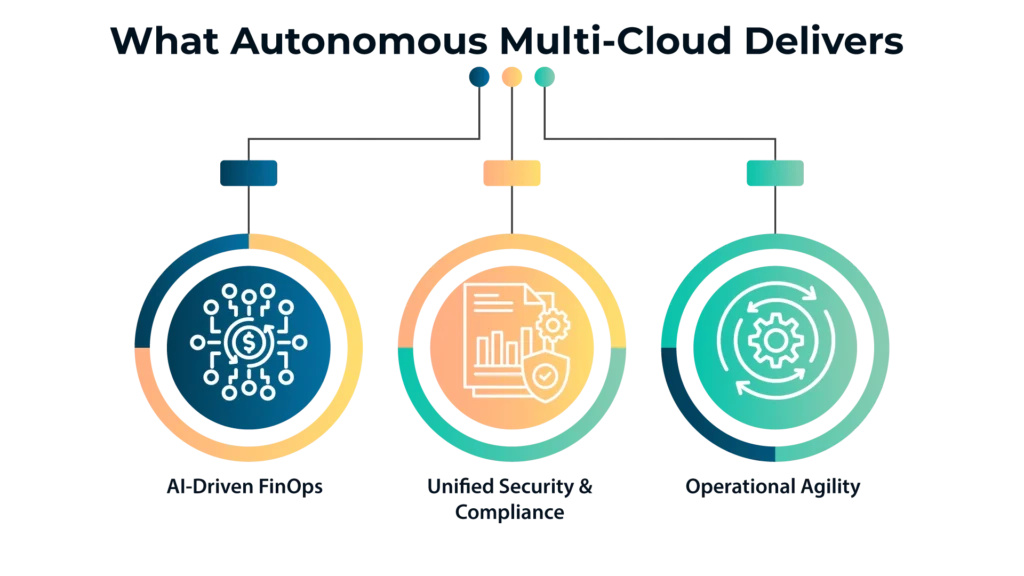
Autonomous FinOps: The Era of Intelligent Cost Optimization
Cloud spending remains a major concern. An estimated 30% of cloud spending is often wasted on idle or oversized resources (Source: Gartner). AI-driven FinOps is the essential game-changer. It shifts the paradigm from reporting waste to preventing it. Switching to a multicloud system is not inexpensive and can lead to high costs due to data egress and application redevelopment.
Real-Time Cost Correction
AI tools continuously monitor usage across all your multi cloud environments. They don’t just report waste; they fix it. This means optimizing costs in real time across multiple cloud.
- Intelligent Right-Sizing: AI analyses workload patterns. It automatically downsizes over-provisioned compute resources. This happens seamlessly across multiple public clouds.
- Predictive Budgeting: AI uses historical data. It accurately predicts potential cost overruns. This proactive warning gives finance and engineering teams time to act.
We must prioritize implementing Financial Operations (FinOps) practices. This is crucial for managing and optimizing cloud spending across the entire multi cloud infrastructure.
Avoiding Vendor Lock-In
A core tenet of any sound multi cloud strategy is to avoid vendor lock in. This means selectively choosing the best cloud providers for specific tasks from different cloud vendors.
Cloud services like:
AWS are known for robust storage;
Microsoft Azure for enterprise tool integration;
Google Cloud for advanced AI/ML capabilities.
The choice among cloud vendors is what provides leverage.
A sophisticated multicloud management platform uses AI. It constantly monitors pricing and feature parity between cloud service providers. It suggests the most cost-effective cloud hosting for each workload. This constant comparison helps organizations effectively avoid vendor lock. It maintains flexibility and prevents over-reliance on one cloud provider.
Unified Security and Compliance: AI’s Security Blanket
Security presents the greatest challenge in a complex multi-cloud world. Each of the different cloud providers maintains a unique security posture. This makes it extremely difficult to maintain consistent security and enforce uniform security policies.
The Zero Trust Model
The Zero Trust security model is not optional. It assumes no user or device is inherently trusted, regardless of location. AI is the only practical engine that can enforce this model across all your scattered cloud environments.
- Automated Policy Enforcement: AI-powered unified governance establishes consistent security policies for access and data across all clouds. It prevents misconfigurations – a leading cause of security risks.
- Continuous Compliance: Multiple cloud services enables organizations to comply with region-specific compliance rules. It does this by switching between on-premises, private cloud, and public cloud landscapes from different vendors. AI constantly scans and auto-remediates any drift from regulatory compliance rules. The focus on security and compliance will only increase.
Ensuring data privacy and robust security measures becomes manageable. AI provides a single interface for policy definition and enforcement across all different cloud services.
Writer Quote: “I’ve reviewed dozens of multi cloud environments. The truth is, without intelligent automation to enforce consistent security policies and optimize costs, the complexity will always eat away at the flexibility you gain. AI is the only tool that can handle that matrix.”
Operational Agility: From Firefighting to Foresight
The primary goal of a multi cloud strategy is maximizing application performance and ensuring robust disaster recovery. You want the best features from multiple providers. This is why dealing with multiple vendors is worth the effort – if you have the right tools.
Intelligent Automation
AI allows organizations to deploy and scale workloads. It implements security policies consistently across all cloud environments. Automation tools like Terraform can reduce manual errors in multi-cloud environments.
- Predictive Maintenance: AI analyzes telemetry data from cloud infrastructure across multiple cloud systems. It predicts potential failures – like an overloaded network segment – before they impact users.
- Self-Healing Workloads: The system can automatically scale applications across different providers to optimize performance. It can automatically migrate a failing container to a healthier cloud platform on another cloud provider. This ensures business continuity and reduces unplanned downtime. Multicloud allows organizations to back up critical applications to ensure availability during disasters or outages, an essential element of disaster recovery.
Multi-Cloud and Hybrid Cloud Integration
A strong multi cloud approach often includes hybrid cloud elements. It combines the public cloud with a private cloud. This creates even more challenging multiple cloud environments. AI-driven orchestration can manage these hybrid cloud deployments as a single, coherent system. The multicloud and hybrid cloud architecture is complex, but AI streamlines it all.
The Path to Autonomous Cloud Platform Adoption
Switching to a fully autonomous multi cloud system is not inexpensive. Setting up a complex multicloud infrastructure requires advanced technical expertise. However, the operational benefits of the autonomous cloud far outweigh these challenges.
Strategy is Key
A successful multi-cloud strategy requires intentional planning. Organizations must:
- Define Goals: Clearly state the vision. The primary goal of a multicloud strategy is to give you flexibility.
- Assess Workloads: Determine which workloads belong on which cloud providers based on specific needs. For example, using Google Cloud for AI or AWS for specific data storage. Organizations should strategically evaluate cloud providers based on their best-in-class services.
- Invest in Skills: Investing in skill development is crucial. AI tools reduce the burden, but human oversight is still key. Organizations must manage the varying features and APIs of different cloud service providers.
The Role of the AI Cloud service Providers
From an architect’s perspective, the true power of an AI-first multi cloud strategy lies in the abstraction layer. The multicloud management platform must provide a single interface to manage workloads across multiple cloud platforms from multiple cloud providers.
The move is toward cloud native application technologies and heavy automation. The data is clear: 70% of organizations are using (or planning to use) AI to support their multicloud environment (Source: HashiCorp). The cloud computing environment is rapidly becoming self-governing.
Writer Quote: “The promise of the autonomous cloud is fundamentally about empowering teams. When you can provision complex multi cloud deployments using just a natural language query, ‘Spin up the new staging environment on the cheapest provider in Europe’; you move from being a cloud operator to a business driver. That’s the real transformation. This is only possible through effective multicloud solutions.”
The Writer’s Perspective: Seeing the Shift in Cloud Services
As a writer focused on this convergence of AI and cloud environments, the pattern is clear: the operational burden of managing diverse multi-cloud strategies is simply unsustainable for human teams. AI is not a luxury; it is the operational necessity for achieving true scale and efficiency. This is vital to avoid vendor lock and leverage the best of different cloud services.
Writer Quote: “The best multi cloud strategy is one that allows you to confidently leverage multiple providers without fear of being trapped. AI-driven platforms act as the ultimate escape key, continuously ensuring you get the best features from all cloud vendors while minimizing your risk. This is the only way to avoid vendor lock in.”
Introducing Cloudeva.ai: The Autonomous Cloud Solution
You’ve read about the future: a multi-cloud system that manages itself, cuts costs automatically, and enforces consistent security across every cloud platform. This is the core power of the AI-first approach for multicloud management tools.
Cloudeva.ai is the platform that transforms this vision into your operational reality. Built on advanced AI frameworks, Cloudeva.ai delivers:
- Intelligent Automation: Autonomous orchestration and self-healing for your entire multicloud infrastructure.
- Natural Language Interactions: Control your cloud environments with simple text commands.
- Autonomous Cloud Operations: The platform makes real-time, optimized decisions for you, giving you a powerful multicloud management capability.
Final Thoughts
The multi cloud approach is a necessity for modern, resilient organizations. It allows for the best blend of public cloud and hybrid cloud resources. It is the key to achieving optimal application delivery and robust business continuity. The multi cloud adoption rate shows this is the way forward.
If you are serious about achieving massive cost reduction, eliminating vendor lock in, and securing your complex multi cloud environments with true autonomy, it’s time to see the self-operating cloud in action.
Ready to Ditch the Multi-Cloud Manual? Request a Free Autonomous Cloud Demo with Cloudeva.ai Today
Stop spending time managing your cloud. Start using AI to let your cloud manage itself.
Keynote Summary: Over 89% of organizations now use multi-cloud environments (Flexera), but the complexity is overwhelming human teams. Each cloud provider has its own APIs, tooling, and management interfaces – making unified governance nearly impossible manually. AI is now mandatory for multi-cloud management at scale, functioning as a unified control plane that transforms reactive management into proactive, autonomous operations.
FAQs:
Why can’t humans manage multi-cloud manually?
The volume of real-time data, the speed of infrastructure change, and the diversity of provider APIs make manual oversight infeasible at enterprise scale.
What does an AI control plane for multi-cloud do?
It aggregates signals across providers, detects anomalies, correlates changes with cost and risk impact, and surfaces recommended actions to human decision-makers.
Is fully autonomous cloud management safe?
Autonomous detection and advising – yes. Autonomous execution without human approval requires governance guardrails and clear policy boundaries.
How does AI reduce multi-cloud complexity?
By normalizing events across different provider formats into a unified signal layer that teams can act on without switching tools.
What’s the risk of not adopting AI for multi-cloud?
Escalating cloud waste, security gaps, delayed incident response, and governance failures as environments grow faster than teams can track.