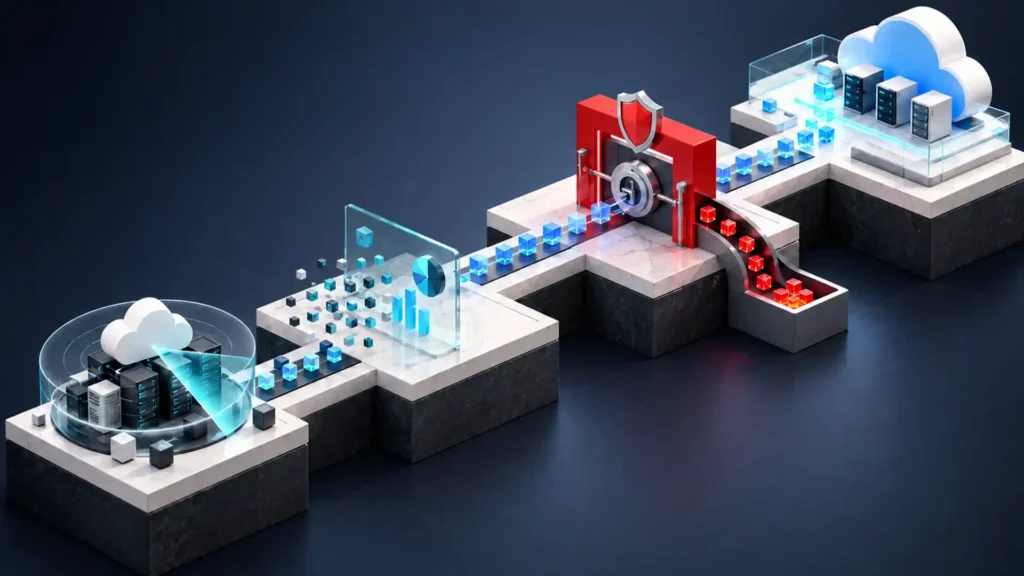
Most teams can describe what their cloud looks like today. Far fewer can control what it becomes tomorrow. Dashboards, cost reports and signals are now standard, yet the same open storage buckets, oversized instances and untagged resources keep appearing. Seeing a problem and preventing it are two different capabilities.
Closing that gap is the purpose of cloud governance automation. With ai cloud governance now part of the conversation, it is tempting to jump straight to software that changes production on its own. That is the fastest way to lose trust, because automation without guardrails only helps you make mistakes at scale.
This guide from Cloudeva.ai lays out a five-rung ladder for moving from monitoring to safe, policy-bound execution. It covers the capabilities each stage needs and example policies you can adapt.
Why Most Cloud Governance Stalls at Observation
Observation is where almost every governance program starts, and for good reason: you cannot govern what you cannot see. The trouble is that many programs never leave this stage. Findings pile up in dashboards and ticket queues, and people remain the only enforcement layer.
The data backs this up. Flexera’s 2026 State of the Cloud Report, based on 753 respondents, estimates wasted cloud spend at 29%, the first increase in five years, and attributes it to rising cost complexity from AI and newer IaaS and PaaS services. Yet 71% of organizations now run a Cloud Center of Excellence and 63% have a FinOps team. Staffing governance roles and reporting on waste did not, on their own, stop the number rising.
Three things usually keep teams stuck:
- No clear ownership. When a problem is flagged but no team is responsible for it, nobody fixes it.
- No safe way to act. Fixing a resource means touching production, and nobody wants to be the person who broke it.
- No shared rules. Each team defines “acceptable” differently, so enforcement turns into negotiation.
This is also why the market for cloud governance tools feels confusing. In our view, most products fall into one of five groups: monitoring and observability, cost management, posture and compliance scanning, policy engines, and automation and workflow tools. The first three tell you what is wrong. Only the last two can change what happens next. A program that owns only the first three will produce excellent reports and very little control.
The same holds whether your estate is public, private, or hybrid. Cloud governance automation always starts with visibility and ends with controlled action, and the rungs below apply in all three environments. Moving up means adding capabilities in order, not buying everything at once.
The Five Rungs of the Cloud Governance Ladder
A cloud governance framework is the set of agreed rules, roles and controls that decide how cloud resources are created, changed and retired. The ladder is a maturity model inside that framework. Each rung depends on the one below it, and skipping a rung is the most common reason automation projects fail.
Rung 1: Observe (Cloud Spend Visibility and Governance Best Practices)
Goal: A trustworthy, complete picture of resources, spend, configuration and change activity.
Capabilities needed: A unified inventory across accounts and regions, cost data at the resource level, and configuration and change logs.
The practices that matter most here are consolidating every account into one view, refreshing data often enough to catch drift, and agreeing on a single definition of “resource” and “owner.”
Example policy: Any account not reporting into the central inventory is flagged within one day.
Rung 2: Attribute
Goal: Every resource and every dollar traced to a team, service and environment.
Capabilities needed: Tagging or labeling standards, ownership mapping and cost allocation.
Attribution is what turns a finding into a task, because someone can now be asked to act on it. It mirrors the FinOps Foundation’s allocation capability, which uses accounts, tags, and labels to create accountability. Its guiding principle is “Everyone takes ownership for their technology usage,” and allocation is what makes that possible.
Example policy: A resource missing an owner or environment tag is reported to the account owner within 24 hours.
Rung 3: Detect and Advise
Goal: Turn rules into detections. Policies run in “detect” mode: they flag violations and recommend a fix, but change nothing.
Capabilities needed: A policy engine, severity levels, routing into chat and ticketing tools, and a way to handle exceptions.
Detect mode lets you measure false positives before any rule can block anyone’s work. Policy engines support this natively. In Kyverno, for example, Audit mode allows the resource and records the violation in a policy report, while Enforce mode blocks it.
Example policy: Raise a signal when a storage bucket becomes publicly readable, or when a non-production instance runs continuously over a weekend.
Rung 4: Control
Goal: Stop risky changes before they land. This is where cloud change management stops being paperwork and becomes a system.
Capabilities needed: Pre-deployment checks in pipelines, approval workflows scaled to risk, change windows, and audit trails linking each change to a requester and a reason.
Example policy: Deployments that expose a database to the public internet are blocked, and changes to production networking need approval from a named owner. Low-risk changes flow through without approval, which keeps engineers on your side.
Rung 5: Automate (Policy-Bound Execution)
Goal: The system makes approved changes itself, within limits you define.
Capabilities needed: Automated remediation with rollback, blast-radius limits, dry-run previews and complete logging.
Example policy: An idle development instance is shut down overnight and restarted on request, while a production resize can be proposed but never executed without approval.
The phrase that matters is policy-bound. Automation at this rung is not autonomy. Cloud governance automation should only do what a policy explicitly permits, and it should be able to prove that afterwards.
AI Cloud Governance: Closing the Loop Automatically
Rungs 3 to 5 depend on a loop: detect, decide, act, verify. Historically, people have been the slow part of that loop. AI cloud governance speeds it up and makes cloud governance automation practical at scale, without removing the rules. In practice, AI adds value in four places:
- Separating real risk from noise
- Tracing a finding to its likely cause
- Drafting a remediation for review
- Verifying afterwards that the fix worked and nothing else drifted
The key design choice is that AI proposes and policy decides. A model can suggest resizing a database cluster, but a policy determines whether that suggestion is auto-approved, sent for review or rejected. That keeps every action explainable, which matters when auditors ask why a change was made.
AI Agent Cloud Governance: Guardrails for Autonomous Actions
As teams give agents access to cloud APIs, ai agent cloud governance becomes its own discipline. OWASP’s AI Agent Security Cheat Sheet advises applying least privilege to all agent tools and permissions and requiring human-in-the-loop approval for high-risk actions.
In practice, that means scoped credentials that expire, spend and action limits, and a full log of every call. A useful rule is that an agent should never hold a permission its policy would not grant a human in the same role.
Closing Cloud Token Governance Gaps
Cloud token governance gaps are one of the quieter risks in this area, and they come in two kinds. The first is credentials. OWASP’s agentic risk list includes Identity and Privilege Abuse (ASI03), where agents inherit or escalate high-privilege credentials.
The second is consumption. OWASP’s LLM10 describes excessive, uncontrolled inference that leads to denial of service and economic losses. Both need an owner, a limit and an expiry, like any other cloud resource.
Turning Guardrails into Policy: Kubernetes and Cloud Cost Governance
A guardrail is an intention. A policy is that intention written so a machine can check it. Good policies are specific, testable and tied to one of three outcomes: preventing risky changes, costly changes or non-compliant changes.
| Outcome | Example policy | Enforcement |
| Risky | Block public exposure of databases and storage | Block at deploy |
| Risky | Require named-owner approval for production IAM changes | Approval gate |
| Costly | Block instance sizes above an approved limit in development | Block or approve |
| Costly | Shut down non-production environments outside working hours | Automate |
| Non-compliant | Require encryption and approved regions for data stores | Block at deploy |
| Non-compliant | Require owner, environment and cost-center tags | Block or flag |
Cloud cost governance is the part of the ladder that finance and engineering can most easily agree on, because the rules are concrete: budget thresholds, tagging requirements and limits on what can be provisioned. Cost policies only work well once Rung 2 is in place. You cannot enforce a budget for a team you cannot identify.
Cloud change management tip: We recommend starting every new policy in detect mode for a few weeks. Review the false positives, agree on exceptions, then move it to enforcement. Policies that block work without warning are the ones teams learn to route around.
Kubernetes Cost Governance Policies in Practice
Shared clusters hide waste behind shared nodes, so FinOps and engineering teams need rules that apply before a workload runs. Kubernetes admission control intercepts a request before the resource is stored, so a non-compliant workload can be stopped before it costs anything.
Two Kubernetes cost governance policies to start with: require CPU and memory requests and limits on every container, which a ResourceQuota can enforce per namespace, and require a team label on every namespace so each cost has an owner.
Where Cloudeva.ai Fits: Explain → Verify → Advise
Most cloud governance tools stop at detection and reporting. Cloudeva.ai adds the missing layer: a governed decision. Built from patterns across 650+ enterprise cloud engagements, it works with read-only access to your existing cost, security, and infrastructure tools rather than replacing them, so it governs decisions without taking control of your infrastructure. Eva Advisor works through three stages: Explain → Verify → Advise.
- Explain: Every signal is broken down into Change, Impact, and Context: what changed, what it costs or risks, and the context behind it, including who made the change and whether it creates a compliance risk.
- Verify: The change is checked against your governance policies and ownership rules before it becomes a cost problem or a compliance violation.
- Advise: Eva Advisor recommends an action in plain language, and your team decides. Nothing is acted on automatically.
Each recommendation lands in the Decision Queue, where your team can accept it, reverse the change, or defer action with a documented rationale. That is where cloud change management becomes a recorded decision instead of a ticket.
Every decision becomes a Decision Record: a permanent, searchable log of what changed, who reviewed it, what was decided, and why, which gives you an audit trail for every change. Cost signals and risk signals sit in the same queue, so FinOps, security, and compliance teams work from one view. For regulated sectors such as BFSI, where every change needs a defensible record, that trail turns a written policy into evidence an auditor can review.
What Policy-Bound Execution Looks Like in Practice
Consider a common case: an oversized development cluster that runs around the clock.
- Observe: Visibility shows the cluster sits idle nights and weekends.
- Attribute: Tags identify the owning team and the environment.
- Evaluate: A policy states that non-production clusters scale down outside 8am to 8pm.
- Execute: Automation scales the cluster down at 8pm and notifies the owner, with a one-click restore.
- Verify and log: The savings and the action are recorded, tied to the policy that authorized them.
Nobody wrote a ticket and nobody was surprised. Every action traces to a rule, and every rule has an owner. That is policy-bound execution, and it is what mature cloud change management looks like.
Before you climb a rung, check that:
- You can name the owner of every resource
- New policies run in detect mode and false positives are measured
- Every automated action has a rollback and a log
- Exceptions are time-boxed and approved
Cloud governance automation is a ladder you climb one rung at a time, and the safest teams never skip the ones that build trust. To see how Cloudeva.ai turns cloud signals into governed, human-approved decisions, book a demo or start a 14-day trial at zero cost (sign up). Sharp. Smart. Certain.
Frequently Asked Questions
What is a cloud governance ladder? +
A cloud governance ladder is a maturity model that shows how organizations move from watching their cloud to controlling it. It has five rungs: observe, attribute, detect, control and automate. It sits inside a broader cloud governance framework, the rules, roles and controls that define how cloud resources may be created and changed. The ladder shows the order in which to build those controls.
How does AI automate cloud governance policy enforcement?+
AI cloud governance uses models to detect violations, filter noise, trace root causes and draft fixes. Enforcement itself stays rule-based: policies decide whether a proposed action is approved, sent for review or blocked. Automated actions run with limits, rollback and logging, so AI speeds up the loop without operating outside the rules. That is how cloud governance automation stays safe as it scales.
What are the biggest cloud governance gaps in 2026? +
Common gaps include incomplete ownership and tagging, findings that never turn into action, inconsistent change approvals and unmanaged permissions for AI agents. Cost is the visible symptom: Flexera's 2026 report shows estimated wasted cloud spend rising to 29%, the first increase after five years of decline. Cloud token governance gaps are a growing one: long-lived credentials with excess access, and model-token spend that nobody caps or attributes.
How does cloud governance differ from cloud cost governance? +
Cloud governance covers how cloud is used across security, compliance, reliability, change control and cost. Cloud cost governance is the subset focused on spend: budgets, allocation, tagging and provisioning limits. Cost rules are often the easiest first policies, because engineering and finance tend to agree on them.
What tools enforce cloud governance policies automatically? +
Enforcement usually comes from policy engines such as Kyverno and OPA Gatekeeper, which plug into Kubernetes admission control, along with infrastructure-as-code checks in CI/CD pipelines, cloud-native policy services, and automation tools that execute approved remediations. Monitoring tools alone do not enforce anything. Look for support for detect mode, approvals, rollback and audit logs.