
From commands to conversations, how human language is becoming the control plane for modern cloud environments
Informative Snapshot: Why This Shift Matters
By 2026, nearly 98% of organizations are operating across at least two infrastructure providers, making multi cloud operations the default, not the exception. At the same time, teams report spending over 30% of their operational time navigating dashboards, writing scripts, and switching tools just to answer basic questions about cloud infrastructure.
Natural language processing is fundamentally changing this equation – replacing rigid CLI commands with conversational, intent-driven interaction across multicloud deployments.
What Is a Multi Cloud Environment?
A multi cloud environment refers to the use of services from multiple cloud providers, typically involving multiple public clouds such as AWS, Azure, and Google Cloud. Unlike a single-vendor setup, a multiple cloud model enables organizations to distribute workloads, optimize performance, and reduce dependency on one provider.
Multicloud deployments often arise deliberately through a multi cloud strategy, but they can also emerge unintentionally due to shadow IT or decentralized teams choosing different vendors.
At scale, multi cloud becomes less about choice and more about survival: resilience, flexibility, and negotiation power depend on it.
Hybrid Cloud vs Multi Cloud
While often confused, hybrid cloud and multi cloud are not the same.
A hybrid cloud combines a private cloud with one or more public cloud environments, allowing data and workloads to move between them. A multi cloud setup, by contrast, focuses on using multiple public clouds, and it does not necessarily include a private cloud.
In practice, many enterprises operate both – hybrid cloud for compliance-sensitive workloads, and multi cloud for innovation and scale.
Why Multi Cloud Is Better for Modern Enterprises
A multi cloud approach enhances resilience by eliminating single points of failure. If one provider experiences an outage, workloads can shift to another. It also allows organizations to select best-of-breed cloud services, for example, using one vendor for AI workloads and another for enterprise applications.
However, with flexibility comes complexity. Managing multiple vendors, billing models, APIs, and security postures introduces significant operational overhead, this is where natural language becomes transformative.
The Problem with CLI-Driven Multicloud Management
Command-line interfaces are powerful but unforgiving. They require precision, context switching, and deep platform knowledge. In large multicloud deployments, teams must remember provider-specific syntax, APIs, and tooling.
As environments grow, CLI-based workflows slow down decision-making, increase cognitive load, and create bottlenecks: especially for non-specialist stakeholders who still need answers.
Whereas natural language understanding can speed the mining of information from financial statements, annual and regulatory reports, news releases or even social media.
Natural Language as the New Control Plane
Natural language changes the interaction model entirely. Instead of writing scripts, users ask questions. Instead of parsing logs manually, systems summarize outcomes.
At the core of this shift is natural language processing (NLP), a subfield of computer science and artificial intelligence that enables machines to understand, interpret, and generate human language.
What Is Natural Language Processing?
Natural language processing is a discipline that uses machine learning, deep learning, and computational linguistics to help computer programs process words, interpret context, and extract significant meaning from text and speech.
NLP enables systems to recognize, understand, and generate text and voice by combining linguistic rules with statistical NLP and neural networks.
Key NLP Facts You Should Know
- NLP is a subfield of computer science and artificial intelligence that uses machine learning to understand and generate human language.
- NLP combines computational linguistics with statistical modeling, deep learning, and machine learning methods.
- NLP is widely used in chatbots, language translation, text summarization, and speech recognition software.
- NLP enhances analysis of unstructured text data like reviews, financial reports, and social media.
Language Processing Meets Cloud Operations
Language processing allows systems to interpret user queries like:
“Show me unused compute across all public cloud accounts” or
“Which cloud vendors are driving cost spikes this month?”
Behind the scenes, NLP models transform input data into structured intent that cloud platforms can act on.
How NLP Understands Human Language – Computational Linguistics
Understanding human language is complex. Words refer to different things depending on context, sentence structure, and emotional tone.
NLP systems rely on multiple NLP tasks, including:
- Part of speech tagging
- Dependency parsing
- Constituency parsing
- Word sense disambiguation
NLP techniques include part-of-speech tagging, word-sense disambiguation, speech recognition, machine translation, and named-entity recognition.
These techniques help identify how words relate to each other, whether two distinct concepts are being referenced, or whether different terms refer to the same entity.
Named Entity Recognition in Cloud Contexts
Named entity recognition and entity recognition allow NLP systems to identify cloud resources, regions, services, and vendors from raw text data.
For example, recognizing that “EC2,” “compute instance,” and “virtual server” may refer to the same entity across different vendors is critical in multicloud management.
Semantic Analysis and Meaning
Semantic analysis enables NLP systems to extract significant meaning beyond keywords. It helps differentiate between similar phrases that carry different intent.
This is essential when users interact with multicloud environments using one language while querying multiple vendors with different terminologies.
Machine Learning and Deep Learning Foundations
Modern NLP relies heavily on machine learning, deep learning, and deep learning models trained on massive language data sets.
Neural networks: particularly transformer-based language models – enable systems to learn syntax, context, and intent rather than relying on hard-coded rules.
NLP Models Powering Machine Translation
NLP models process text data and voice data to enable conversational interfaces across cloud infrastructure. These models continuously improve as they ingest new input data and feedback.
They enable not just understanding, but also natural language generation, allowing systems to generate human language responses that are context-aware and actionable.
Speech Recognition and Voice-First Cloud Ops
With advances in speech recognition, speech processing, and speech to text, cloud management is no longer limited to keyboards.
Voice-operated GPS systems paved the way; now similar concepts are applied to cloud operations, where spoken commands can trigger insights or actions across multicloud deployments.
From Text to Action Across Multiple Clouds
In a multicloud architecture, NLP translates natural language into structured queries that interact with APIs across multiple public clouds.
This removes friction between intent and execution: bridging the gap between business questions and technical systems.
Multicloud Architecture and NLP Integration
A modern multicloud architecture relies on a centralized control layer that aggregates telemetry, billing, and security signals.
NLP sits on top of this layer, acting as an interface that simplifies interaction across different vendors and software environments.
Multicloud Management at Scale
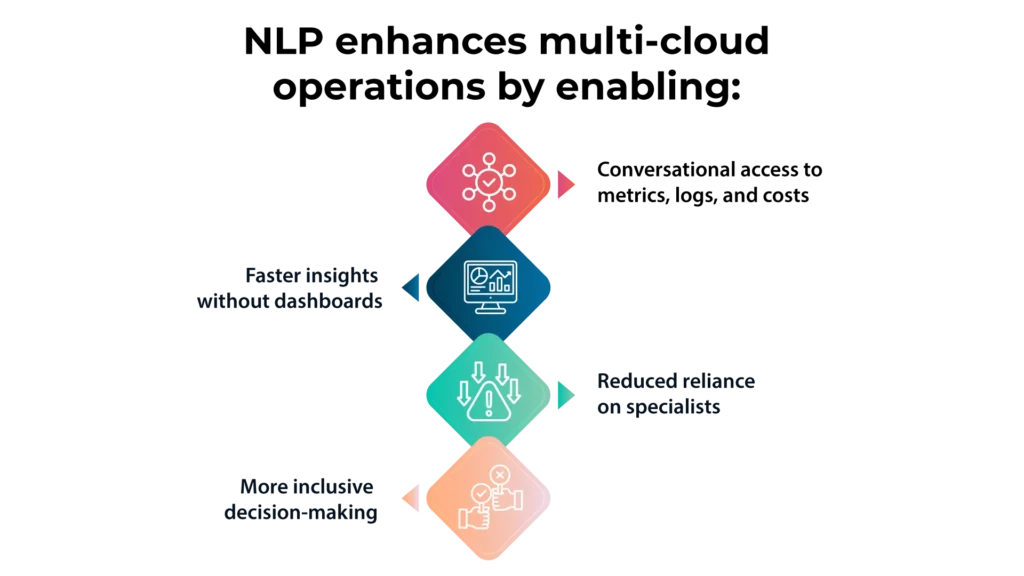
Multicloud management requires unified visibility, automation, and governance. NLP enhances this by enabling conversational access to metrics, logs, and configurations.
Instead of navigating dashboards, teams can query systems directly using natural language, accelerating insights and reducing dependency on specialists.
Multicloud Strategy in 2026
The cornerstone of a multicloud strategy in 2026 is a centralized management platform with a unified view across providers.
Natural language interfaces are becoming a competitive differentiator: reducing operational overhead and enabling faster, more inclusive decision-making.
Cost, Risk, and Governance with NLP
NLP can analyse claims, financial reports, and usage logs to identify inefficiencies and anomalies across multicloud deployments.
By processing unstructured text data, NLP tools help organizations manage hidden costs, duplicated services, and fragmented billing across different vendors.
Security and Compliance Insights
In complex multi cloud environments, NLP helps automate legal discovery, compliance reviews, and risk analysis by extracting relevant details from vast text data sources.
This supports identity-centric security models and Zero Trust approaches across public cloud and private cloud environments.
What Is Natural Language Generation Used For?
NLP is used for text translation, machine translation, sentiment analysis, text summarization, chatbots, and voice interfaces.
In cloud computing, NLP is increasingly used to simplify operations, analyze logs, and improve accessibility to complex systems.
What Are the Four Types of NLP?
Broadly, NLP can be grouped into:
- Syntax-focused tasks (parsing, sentence structure)
- Semantic-focused tasks (meaning and context)
- Speech-based processing (voice data, speech recognition)
- Generation-focused tasks (natural language generation)
What Is AI in NLP?
AI in NLP refers to the use of artificial intelligence techniques – especially neural networks and deep learning, to enable systems to learn language patterns rather than follow static rules.
This makes NLP adaptable, scalable, and suitable for dynamic environments like multicloud deployments.
Is NLP Therapy the Same Thing?
No. NLP therapy refers to Neuro-Linguistic Programming, which is unrelated to natural language processing in technology. Despite sharing an acronym, they are two distinct concepts.
The Future: One Language, Many Clouds
The future of cloud operations is conversational. One language – human language, will increasingly control multiple cloud environments.
As NLP technology matures, managing multicloud deployments will feel less like programming and more like collaboration between humans and intelligent systems.
Final Thought
Moving from CLI to NLP is not just a usability upgrade, it is a structural shift in how humans interact with cloud infrastructure.
In a world of multiple cloud providers, complex architectures, and constant change, natural language may become the most powerful abstraction layer of all.
Ready to Manage Multi Cloud Services in Plain Language?
Cloudeva.ai brings natural language–driven intelligence to complex multicloud deployments, turning scattered data, tools, and vendors into a single, conversational control plane. Ask questions in human language, get unified insights across public cloud and private cloud environments, and move from visibility to action faster.
Explore how Cloudeva.ai simplifies multicloud management with AI-native automation, conversational cloud operations, and predictive intelligence, so your teams spend less time navigating clouds and more time optimizing them.
Keynote Summary: By 2026, 98% of organizations operate across two or more cloud providers, yet teams spend 30%+ of operational time navigating dashboards and switching tools. Natural language processing (NLP) is replacing rigid CLI commands with conversational, intent-driven cloud management – allowing engineers to query, govern, and act across multi-cloud environments without scripting expertise.
FAQs:
What is natural language cloud management?
Using plain-language queries to interact with cloud infrastructure instead of CLI commands or dashboard navigation.
What is the difference between hybrid cloud and multi-cloud?
Hybrid combines public and private cloud; multi-cloud uses multiple public clouds without necessarily including a private environment.
Why is NLP useful for cloud ops?
It reduces the skill barrier, speeds up queries, and makes multi-cloud context accessible to non-engineers.
What operational time does multi-cloud management consume?
Over 30% of team time on dashboards, scripts, and context-switching – NLP aims to recover that.
Does NLP replace cloud expertise?
No – it reduces friction for common queries and accelerates decisions; deep expertise is still required for architecture and governance.
Frequently Asked Questions
Which plan is right for a team just starting with cloud governance?+
Starter is designed for teams that want visibility first: every change explained and queued for review. As your team moves from reviewing decisions to enforcing policy around them, Growth and Pro add the verification and advisory depth that active governance needs.
Can I change plans as my cloud footprint grows?+
Yes. Plans are designed as a maturity path — you can move up as your accounts, teams, and governance needs grow, keeping your existing decision history, records, and review cadence intact.
Is there a free trial?+
Yes. Every plan starts with a 14-day free trial, so your team can connect a cloud account through a read-only role and see its own changes flowing through the Decision Queue before committing.
Do all plans support AWS, Azure, and Google Cloud?+
Yes. AWS, Azure, and GCP are first-class providers on every plan. Multi-cloud environments are governed in a single view, with each change attributed to its cloud, account, and actor.