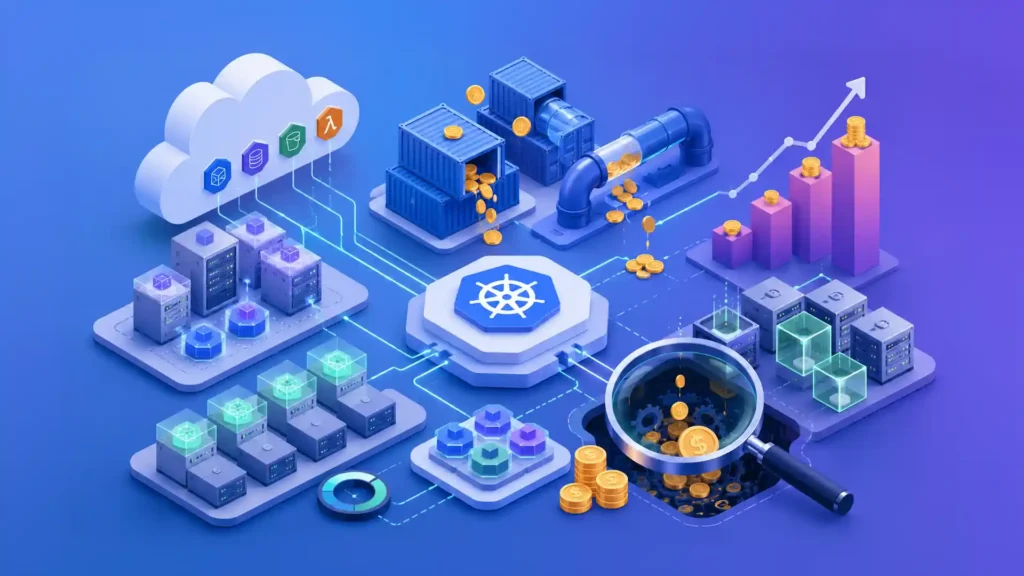
Cloud FinOps for Kubernetes: The Hidden Cost Problem Most Enterprises Ignore
You have dashboards. You have budget signals. You might even have a FinOps team.
And yet Kubernetes is still silently generating cloud costs that none of your current tools can fully see, attribute, or govern.
BY THE NUMBERS
| 68% of enterprises say Kubernetes costs are “partially or not visible” in their FinOps tools CNCF Annual Survey, 2025 | 40% average Kubernetes resource waste across enterprise clusters Kubecost State of K8s 2025 | $2.7M average annual cloud waste attributable to unmanaged Kubernetes spend in mid-enterprise Gartner, 2025 |
What Is Cloud FinOps and Why Kubernetes Breaks the Model
Before diving into Kubernetes specifically, it is worth being precise about what cloud FinOps actually is.
The FinOps Foundation defines it as a cultural and operational model that enables organisations to make real-time trade-off decisions between speed, cost, and quality not after the invoice lands.
In practice, a mature FinOps cloud programme does three things consistently: it makes costs visible at the team and workload level, it creates accountability so engineers own the cost of their choices, and it builds a decision governance layer so every cost signal ends in a verified outcome rather than an unresolved backlog item.
Kubernetes disrupts all three.
It introduces a layer of abstraction pods, namespaces, nodes, clusters that sits between your workload and the billing line items your native cloud tools understand. The result is a systematic visibility gap that compounds silently, month after month.
| ⚠ WATCH OUT |
| Native billing tools Azure Cost Management, AWS Cost Explorer, GCP Billing Console report costs at the VM or node level. They cannot tell you which namespace, deployment, or team generated those costs. Without that attribution, accountability is impossible. |
The Kubernetes Blind Spot in Your Cloud FinOps Tools
Most organisations discover the Kubernetes cost problem when a cost anomaly appears in their native billing console with no clear owner.
The cluster spent $180,000 last month. But which team? Which service? Which deployment decision caused the spike?
The answer is not in the billing console. It is in cluster-level telemetry that most cloud FinOps tools were never built to read.
In the CNCF’s 2025 annual survey, 68 percent of enterprise respondents reported that Kubernetes costs were either partially visible or entirely invisible in their existing FinOps tooling. The gap is structural native billing tools aggregate to the node, not to the workload.
“The fastest-growing line item on most enterprise cloud invoices in 2026 is a number that nobody in the room can explain.”
— FinOps Foundation, State of FinOps 2025
The compounding problem is that Kubernetes environments are dynamic. Pods scale up and down. Namespaces are created by individual teams without cost attribution. Resource requests are set optimistically and never reviewed. Every one of these patterns adds spend that is invisible to the finance team and unowned by any engineer.
Understanding how cloud billing tools construct their account-level summaries and where Kubernetes spend disappears inside those summaries is the essential first step.
For a broader foundation on cloud cost governance, read our guide on Cloud Cost Management with FinOps: Azure Best Practices That Actually Work.
Where Kubernetes Waste Actually Hides
Understanding the specific sources of Kubernetes waste is the prerequisite to governing it. There are four patterns that account for the majority of overspend in enterprise clusters.
Over-provisioned resource requests
Kubernetes allocates compute based on resource requests, not actual usage. An engineer sets a memory request of 4 GB for a service that uses 600 MB at peak. The cluster reserves the full 4 GB. The node is billed. The 3.4 GB is wasted. Kubecost’s 2025 research found that the average enterprise cluster runs at 40 percent utilisation against provisioned capacity.
Idle node capacity
Cluster autoscalers scale up aggressively and scale down slowly. Nodes provisioned for a traffic spike at 2pm remain running at midnight. Without automated right-sizing policies and bin-packing optimisation, idle node cost compounds continuously.
Untagged namespaces
When a new team creates a namespace without cost attribution labels, every pod running in that namespace becomes an unowned cost. Across large organisations, untagged Kubernetes spend routinely runs at 20 to 35 percent of total cluster cost.
Persistent volume orphans
Persistent volumes continue to generate storage costs after the workloads that created them are deleted. In clusters with active deployment cycles, orphaned PVCs accumulate invisibly the cloud equivalent of paying rent on an office nobody uses.
Building a FinOps Cloud Governance Layer for Kubernetes Cost Management
Visibility tools tell you the number. Governance determines what happens next.
Most organisations have the former and lack the latter. A FinOps cloud governance layer for Kubernetes needs to do four things that native billing tools cannot:
- Attribute cost to the team, not the node. Every namespace must map to a team and a budget owner. Cost allocation labels applied at namespace level are the prerequisite for any accountability structure.
- Generate signals with context, not just anomalies. Every signal needs context before a decision can carry confidence. A signal that identifies which deployments caused the overage, names the owning team, cross-references deployment history, and ranks remediation options by financial impact is what governance requires not a raw number with no owner attached.
- Create a decision record for every signal. Every cost anomaly should enter a defined workflow: assigned to an owner, reviewed within a window, decided upon accept, remediate, or defer and verified.
- Verify outcomes, not just decisions. A decision to right-size an overprovisioned deployment is not complete when the ticket is logged. It is complete when the resource request is changed and the cost confirms the expected reduction.
For BFSI organisations and other regulated enterprises, this governance layer carries an additional compliance dimension. Unowned Kubernetes spend is not only a waste problem it is an audit risk. When a regulator asks which team approved a persistent infrastructure change and what its financial impact was, an unattributed namespace is an evidence gap. A tamper-evident Decision Record closes that gap permanently. For BFSI cloud teams operating under internal audit requirements or regional regulatory frameworks, that record is not operationally useful it is the compliance artefact the audit requires.
| 💡 INSIGHT |
| cloudeva.ai’s EVA Advisor applies the Explain → Verify → Advise → Act framework to Kubernetes environments detecting cost signals and risk signals across namespaces, explaining root causes with cross-source evidence, and routing each finding through a structured Decision Queue where every outcome is logged in a permanent, tamper-evident Decision Record. For regulated enterprises, that audit trail is not optional. |
Cloud FinOps Tools for Kubernetes Cost Management: What Each One Does
The pattern is consistent across the market: tools that understand Kubernetes cost allocation lack a decision and governance layer. Tools with governance features have limited Kubernetes granularity.
Before comparing individual tools, the key distinction is this: cloudeva.ai is not primarily a cost attribution tool it is the decision intelligence layer that turns attribution data from any source into governed, verified, auditable outcomes. It connects to Kubernetes-native attribution tools and provides the decision workflow and audit trail that no attribution tool alone delivers.
Here is an honest comparison:
| Tool | Namespace attribution | Decision workflow | Audit trail |
| AWS Cost Explorer | Node-level only | None | None |
| Azure Cost Management | Node-level only | None | None |
| Kubecost | Namespace + pod | None | None |
| OpenCost | Namespace + pod | None | None |
| Apptio Cloudability | With tags | Partial | Limited |
| cloudeva.ai + Kubecost | Full attribution | Structured Decision Queue | Permanent Decision Records |
A combination of a Kubernetes-native cost tool (Kubecost or OpenCost) with a purpose-built decision governance layer closes both gaps simultaneously.
Cloud FinOps Maturity for Kubernetes: Where Are You?
The FinOps Foundation’s maturity model uses three stages Crawl, Walk, Run and most honest self-assessments reveal that organisations are further back than they think.
| Stage | Visibility | Accountability | Decision Governance |
| Crawl | Basic billing, minimal tagging | No formal ownership | No decision workflow |
| Walk | Tagged resources, budget alerts active | Team-level showback, some chargeback | Informal reviews, no records |
| Run | Real-time anomaly detection, full allocation | Chargeback normalised, cost in sprint reviews | Structured queue, verified outcomes, audit trail |
Most organisations sit firmly in Walk on visibility and early Crawl on decision governance. Closing that gap not acquiring more dashboards is where the return on FinOps investment actually lives.
Five Steps to Close the Kubernetes FinOps Cloud Cost Gap
1. Enforce namespace-level cost labels today
Every namespace needs at minimum three labels: team, cost-centre, and environment. Add a CI/CD policy that blocks namespace creation without these labels. This single change turns unattributed spend into accountable spend within one billing cycle.
2. Deploy a Kubernetes-native cost tool
AWS Cost Explorer and Azure Cost Management cannot give you namespace-level attribution. Kubecost or OpenCost can. Deploy one, integrate it with your existing FinOps tooling, and establish a weekly cost report by namespace and team.
3. Set resource request optimisation as a standing sprint task
Right-sizing resource requests is not a one-time audit. Assign one engineer per team to review namespace utilisation against requests on a two-week cycle. Make it visible in sprint reviews.
4. Build a Decision Queue for cost signals
Every cost signal above a defined threshold should enter a tracked Decision Queue with an assigned owner, a review date, and a required decision. Use a shared tracker if budget does not allow a dedicated tool. The discipline matters more than the medium.
5. Add verification to every decision
One sprint after a remediation decision is logged, someone must confirm the action was applied and the cost reflects the expected reduction. This single step is what separates organisations that sustain Kubernetes savings from those that re-audit the same clusters every six months.
To understand how cloudeva.ai automates this verification step end-to-end logging who decided, what EVA Advisor recommended, and whether the outcome was confirmed read: https://cloudeva.ai/blogs/decision-records-closes-the-loop-on-every-cloud-decision/
The Bottom Line on Cloud FinOps and Kubernetes Cost Management
The question of what is cloud FinOps has a clean answer in theory: shared accountability for cloud spend, with visibility, ownership, and governance working together.
In practice, most organisations have visibility and Kubernetes has broken even that for the fastest-growing part of their cloud estate.
The fix is not a new dashboard. It is a governance layer that attributes Kubernetes cost to the teams generating it, turns cost signals into structured decisions with context and confidence behind them, and verifies that those decisions actually close the loop.
The organisations paying the most for Kubernetes in 2026 are not the ones with the largest clusters. They are the ones still waiting for visibility before they build governance
TAKE ACTION TODAY
See what signals your billing console can’t surface and whether they’re being governed.
cloudeva.ai’s EVA Advisor detects Kubernetes cost signals and risk signals your billing console cannot see, routes each one through a structured Decision Queue with full context attached, and closes every loop with verified, permanent Decision Records from anomaly detection to confirmed outcome.
→ Start at zero cost at cloudeva.ai
See how Cloudeva.ai handles Kubernetes cost governance in a live environment — book a 20-minute demo.
Frequently Asked Questions
1. What is cloud FinOps and how does it apply to Kubernetes?
Cloud FinOps Cloud Financial Operations is the operational practice that aligns finance, engineering, and operations around shared accountability for cloud spend. Applied to Kubernetes, it means attributing cluster costs to the namespaces, teams, and workloads generating them, and building a governance workflow that ensures cost signals lead to verified, recorded actions rather than ignored alerts.
2. Why can’t AWS Cost Explorer or Azure Cost Management show Kubernetes costs by team?
Native billing tools report costs at the infrastructure layer virtual machines, node pools, storage volumes. Kubernetes runs multiple workloads from multiple teams on shared nodes. The billing tool cannot see inside the cluster to attribute costs by namespace or deployment. Kubernetes-native tools like Kubecost and OpenCost read cluster-level telemetry to provide that attribution, which native tools structurally cannot.
3. What cloud FinOps tools work best for Kubernetes cost management?
The most effective stack combines a Kubernetes-native attribution tool Kubecost or OpenCost for namespace and pod-level allocation with a decision governance layer. cloudeva.ai’s EVA Advisor closes the decision and audit loop that all attribution tools leave open: every cost signal enters a structured Decision Queue, every decision is logged in a permanent Decision Record, and every outcome is verified before the loop is considered closed.
4. How much Kubernetes spend is typically wasted in enterprise environments?
Kubecost’s 2025 State of Kubernetes report puts average cluster utilisation at approximately 40 percent of provisioned capacity. Gartner estimates the average mid-enterprise loses $2.7 million annually to unmanaged Kubernetes spend.
5. What is finops cloud governance and why does it matter more than visibility alone?
FinOps cloud governance is the structured workflow that ensures every cost signal anomaly, recommendation, or budget overrun results in a named decision with a verified outcome. Without governance, cloud FinOps programmes cycle endlessly between awareness and disappointment, rediscovering the same waste every quarter.
6. Can I build decision governance without buying a dedicated tool?
Yes. A shared Decision Queue a spreadsheet or project board where every cost signal is logged with an owner, a decision, and a verification date combined with a weekly 30-minute cross-functional review, covers the fundamentals for most teams. Purpose-built tools add value at higher signal volumes and in regulated environments where tamper-evident audit trails are required, but the workflow itself can be built manually.
Frequently Asked Questions
Because the billing unit and the usage unit don't match. Cloud providers bill for nodes; teams consume pods and namespaces. Shared clusters blend many teams' workloads onto the same machines, so the bill shows a cluster total while nobody can see their own share without extra allocation work.
It's applying FinOps practice inside the cluster: allocating shared node costs to namespaces, workloads, and teams; setting requests and limits that reflect real usage; and giving each team visibility and ownership of its share, so optimisation happens where the workloads are actually run.
Start with labels and namespaces as the allocation keys, then split node costs by each workload's resource requests (or actual usage) over time. Unallocated capacity — idle headroom, system overhead — should be shown explicitly rather than hidden, because that gap is usually where the savings are.