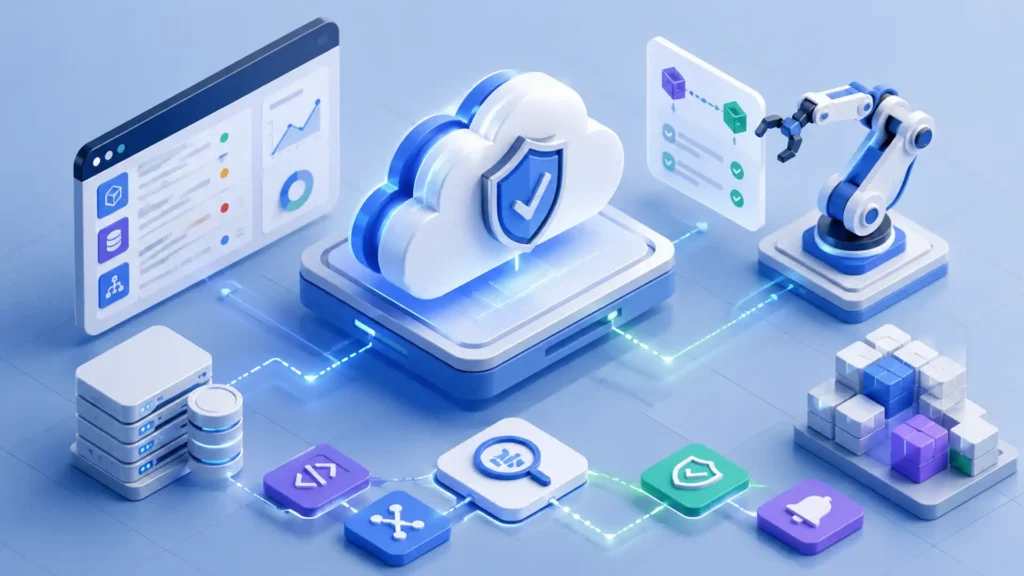
Cloud governance is the set of policies, controls and evidence practices that keep a cloud environment secure, compliant and cost-accountable as it changes. Traditional governance depends on manual review cycles. Automated change intelligence replaces those cycles with continuous detection, attribution and impact assessment of every change — so governance stops being a quarterly scramble and becomes a live state you can query.
That distinction matters more every quarter, because the thing governance is trying to control has changed shape. A cloud estate is no longer a fixed set of servers that someone patches on a schedule. It is a moving system that reconfigures itself hundreds of times a week — through pipelines, autoscaling, IaC applies, console edits and third-party integrations. Governance frameworks built for annual change windows are being asked to supervise an environment that changes faster than anyone can read about it.
The data suggests the gap is widening rather than closing. Flexera’s 2026 State of the Cloud Report found estimated wasted cloud spend rose to 29% of IaaS and PaaS spend — the first increase after five consecutive years of decline — while 85% of the 753 cloud decision-makers surveyed named managing cloud spend as their top challenge. One analysis of the report drew the sharper conclusion: this is not a failure of FinOps discipline, but a signal that complexity is growing faster than governance.
That framing is worth sitting with, because it changes what the fix looks like. If governance is failing because people are not trying hard enough, the answer is more process. If it is failing because the environment outpaces manual review, more process makes it worse.
What is cloud governance?
Cloud governance is the practice of maintaining control over how cloud resources are provisioned, configured, secured and paid for. In practice it rests on four pillars:
| Pillar | The question it answers | What breaks without it |
| Visibility | What exists in our environment right now? | Shadow infrastructure, unknown attack surface |
| Control | Who is allowed to change what? | Privilege creep, unauthorised deployments |
| Accountability | Who made this change, and why? | Unattributable incidents, failed audits |
| Cost discipline | What did that change do to our bill? | Silent budget overruns, unexplained variance |
Most organisations invest heavily in the first two and thinly in the second two. Guardrails get built — service control policies, IAM boundaries, Config rules — and then the accountability layer is left to spreadsheets and human memory. That gap is where governance overhead lives.
Why does traditional cloud governance create so much overhead?
Because it asks people to do work that only machines can do at the required volume.
The raw material already exists. AWS CloudTrail records API activity across an account. AWS Config captures a configuration item every time a tracked resource changes. CloudFormation and Terraform both report when live infrastructure no longer matches its declared template. The signal is not missing.
The problem is that it arrives as an undifferentiated stream. A moderately active multi-account estate can generate tens of thousands of CloudTrail events in a day, the overwhelming majority of them routine reads, health checks and automated service calls. CloudTrail’s console Event history keeps only the last 90 days, so anything older means querying archived logs in S3 — a data engineering exercise, not a compliance workflow.
So compliance teams sample. They pull logs when an auditor asks, reconstruct a timeline for the resource in question, chase the owning engineer over Slack for context, and write it up. That pattern costs them in three places:
- Latency. Changes are reviewed weeks after they happen, when the person who made them has moved on to other work.
- Coverage. Sampling means most changes are never examined at all.
- Credibility. Evidence assembled retrospectively is weaker than evidence captured continuously, and auditors know it.
The consequences are well documented. Gartner’s widely cited prediction held that through 2025, virtually all cloud security failures — 99% — would be the customer’s fault rather than the provider’s. Palo Alto Networks’ 2026 Unit 42 Global Incident Response Report reaches a compatible finding from incident data rather than forecast: in more than 90% of the incidents it examined, misconfigurations or gaps in security coverage materially enabled the intrusion.
Read together, those two figures make an uncomfortable point. The dominant cause of cloud incidents is not adversary sophistication. It is unreviewed change — and unreviewed change is a governance output, not a security one.
What is automated change intelligence?
Automated change intelligence is the continuous collection of every change in a cloud environment, enriched with three things raw logs do not provide: attribution, impact and priority.
A CloudTrail entry tells you an API call happened. Change intelligence tells you that a specific engineer modified a security group on a production database subnet at 02:14, that the change widened ingress from a single CIDR to the internet, that it deviates from the approved baseline, and that it should be reviewed before anything else in the queue.
The difference is interpretation. Logs are a record. Change intelligence is a finding.
Why change attribution is the layer logs leave out
Change attribution is the practice of resolving every change to the identity, role and mechanism behind it — a human in the console, a deployment pipeline, an autoscaling action or a third-party integration. Logs technically contain this, but they contain it as an ARN buried in a JSON payload, not as an answer.
The distinction is operational rather than pedantic. “Who changed this?” is the first question asked in every incident review and every audit interview, and an environment that cannot answer it in seconds will spend hours reconstructing it from memory and chat history. Attribution captured at the moment of change is also the only version that stays accurate, because the people involved forget and move on.
How does automated change intelligence work?
Five stages, running continuously rather than on a review cycle:
- Detect. Ingest change events across every account and region — API activity, configuration item changes, IaC drift signals — into a single normalised timeline.
- Filter. Separate meaningful state changes from routine noise. This is the step that makes the rest usable; without it, teams are handed the same undifferentiated stream they already ignore.
- Attribute. Resolve each change to an identity, a role and, where possible, an originating mechanism — was this a human in the console, a pipeline, an autoscaling action, or a third-party integration?
- Assess impact. Classify each change along the dimensions that matter: security posture, compliance deviation, availability risk, and cost delta.
- Prioritise and evidence. Rank findings by assessed impact, and retain the enriched record as audit-ready evidence with its full context intact.
Cloudeva.ai is built around this sequence, with EVA performing the filtering and impact-assessment stages so that what reaches a compliance team is a short prioritised list rather than a log export.
Manual cloud governance vs automated change intelligence
| Dimension | Manual review | Automated change intelligence |
| Change coverage | Sampled | Complete |
| Time to detection | Days to weeks | Near real-time |
| Attribution | Reconstructed from memory and Slack | Captured at the moment of change |
| Impact assessment | Analyst judgement, inconsistent | Applied uniformly to every change |
| Audit evidence | Assembled retrospectively | Continuously accumulated |
| Effort curve | Scales with estate size | Flat as estate grows |
The last row is the one that decides whether a governance programme survives growth. Manual review is workable at ten accounts and impossible at a hundred.
Which regulations require cloud change management?
Change control is not a nice-to-have in regulated industries — it is an explicit control objective across most frameworks an Indian enterprise will encounter:
- RBI Master Direction on IT Governance, Risk, Controls and Assurance Practices — issued November 2023, effective 1 April 2024. It consolidates earlier circulars into a single framework covering scheduled commercial banks, small finance and payments banks, NBFCs in the Top, Upper and Middle layers, and the All-India Financial Institutions. Its requirements include IT service management controls, maintenance of audit trails, and continuous auditing of critical systems, with findings reviewed by the Audit Committee of the Board.
- SEBI Cyber Security and Cyber Resilience Framework (CSCRF) — consolidated cyber requirements for regulated market entities, including logging, monitoring and traceability of changes.
- Digital Personal Data Protection Act, 2023 — accountability obligations that require knowing where personal data resides and who altered access to it.
- ISO/IEC 27001:2022 — Annex A controls covering change management and logging.
- SOC 2 — change management is a standard Common Criteria control area for service organisations.
- PCI DSS v4.0 — requirements around tracking and monitoring access to system components and cardholder data environments.
Every one of these asks a version of the same question: can you show us the record of what changed, who changed it, and that someone assessed the risk? An environment that can answer that continuously passes cleanly. One that reconstructs answers on request spends audit season doing archaeology.
How do you move to automated cloud governance?
A realistic sequence, without a replatforming project:
- Establish complete capture first. Confirm CloudTrail is enabled organisation-wide across all regions, and that AWS Config is recording in every account you intend to govern. Automation cannot interpret events it never received.
- Define your baseline. Document what “normal” looks like for your critical resource types — expected change frequency, approved change origins, permitted configuration ranges.
- Layer interpretation over the raw stream. Introduce filtering, attribution and impact scoring so that the output is a ranked set of findings rather than a log volume.
- Wire findings into an existing workflow. Governance findings that live in a separate dashboard get checked weekly at best. Route them where your teams already work.
- Convert continuous evidence into audit artefacts. Once every change carries attribution and impact context, audit preparation becomes an export rather than an investigation.
Most teams see the return at step three. Steps one and two are unglamorous groundwork, but skipping them produces a well-designed system reasoning over incomplete data — which is worse than no system, because it looks trustworthy.
Frequently asked questions
What is the difference between cloud governance and cloud security?
Cloud security protects the environment from threats. Cloud governance is broader: it covers security alongside cost accountability, configuration standards, access control and audit evidence. Security is one outcome that good governance produces, but a secure environment can still be ungoverned — and usually is if nobody can explain its costs.
Does CloudTrail give me a cloud audit trail good enough for governance?
No. CloudTrail is a logging service, not a governance layer. It records API activity faithfully but does not filter noise, assess impact, or tell you which of today’s changes matter. It supplies the raw input that a governance capability interprets.
How is change intelligence different from a CSPM tool?
Cloud security posture management evaluates your environment against a policy set and reports violations — a snapshot of state. Change intelligence is temporal: it tracks the transitions between states, who caused them and what each one affected. The two are complementary, not substitutes.
Is continuous compliance monitoring the same as continuous auditing?
Not quite. Continuous compliance monitoring is a control activity run by the operating team — checking, continuously, that the environment still matches policy. Continuous auditing is an assurance activity, performed with independence from the team being examined. Monitoring produces the evidence; auditing tests whether that evidence can be relied on.
Can cloud compliance automation work across multiple cloud accounts?
Yes, and multi-account estates are where it earns most of its value. Aggregating change events across accounts into one prioritised view is precisely the work that does not scale manually.
How long does it take to get value from cloud compliance automation?
If CloudTrail and Config are already enabled, the constraint is connection and baselining rather than instrumentation — meaning first findings arrive quickly. If logging coverage is incomplete, fix that first.
Ready to see what changed in your environment this week — attributed and impact-assessed? Explore Cloudeva.ai →