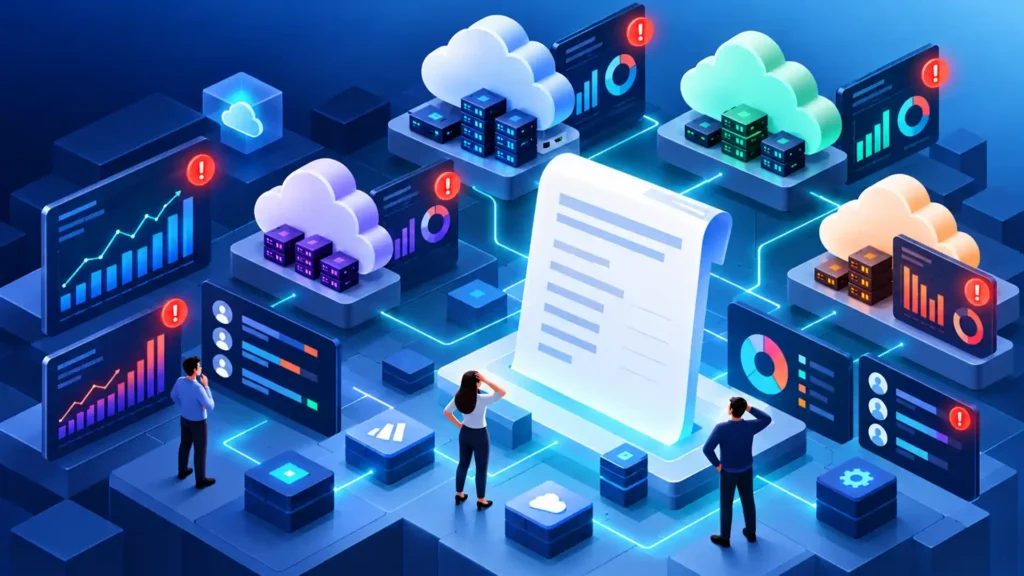
Your FinOps team built its playbook for AWS, Azure, and GCP. Then your ML team signed up for a GPU-specialized cloud nobody in finance had heard of, and the bill for it showed up somewhere nobody was watching.
This is the neocloud problem, and it’s arriving faster than most FinOps practices can adapt. AI training, inference, and rendering workloads are increasingly running on specialized providers built for one job: cheap, dense GPU capacity. Cloud spend visibility across these providers is the gap nobody budgeted time to close.
This piece explains what a neocloud actually is, where the spend disappears, what a real neocloud FinOps practice needs, and what to do about it this quarter, with cloud spend visibility and ai cloud governance as the throughline connecting each section.
What Is a Neocloud and Why Does It Break Your FinOps Assumptions
What Makes a Neocloud Different
A neocloud is a cloud provider built specifically around GPU capacity, for AI training, inference, rendering, or high-performance compute, rather than general-purpose infrastructure. Unlike AWS, Azure, or GCP, most neoclouds have no equivalent of Cost Explorer, no mature tagging schema, and no established integration with the cost tools your FinOps team already trusts.
Why Your Existing FinOps Tools Don’t Transfer
That mismatch is the root of the problem. Cloud cost management for AI workloads assumes a level of billing maturity that neoclouds simply haven’t built yet. Your team can allocate an AWS EC2 instance to a cost center in a few clicks. Doing the same on a neocloud often means manually reconciling a CSV export against a spreadsheet someone maintains by hand, and cloud spend visibility disappears the moment that handoff happens.
An Attribution Problem You’ve Already Seen Before
This isn’t a hypothetical. FinOps teams are already saying versions of the same thing: our FinOps team can’t tell which Kubernetes services are responsible for our cross-AZ data transfer bill, and that’s on infrastructure they understand well. Add a GPU provider with no shared tagging standard, and attribution gets harder, not easier.
Why This Deserves Attention Now, Not Later
Cloud spend visibility was never automatic on AWS, Azure, or GCP either, FinOps teams spent years building the tagging discipline, budget signals, and review cadences that make it possible. Neoclouds are starting from zero on all three, at the exact moment AI spend is growing fastest. That combination is why ai cloud governance and ai cloud cost optimization both need to extend to neoclouds now, not after the first surprise invoice.
AI cloud cost optimization has to start with a basic question most teams haven’t answered yet: do you actually know which team, project, or model run is generating each neocloud invoice line?
Five Ways Neocloud Spend Goes Invisible
Cloud spend visibility breaks down in specific, repeatable ways once a neocloud enters the picture. Here are the five most common.
1. Billing Delays That Outpace Your Review Cycle
Neocloud invoicing cycles are often slower and less predictable than hyperscaler billing. What causes delayed billing notifications from neocloud providers usually comes down to smaller finance teams, manual reconciliation on the provider’s side, or usage-based pricing that isn’t finalized until well after the fact. By the time the invoice lands, the spend decision that caused it is weeks old and nobody remembers approving it.
2. No Shared Tagging Schema
AWS, Azure, and GCP all support structured cost allocation tags out of the box. Most neoclouds don’t, or their tagging is inconsistent across regions and instance types. Without a tagging schema, cost cloud governance has nothing to enforce, and spend defaults to a single line item: “GPU compute.”
3. Cross-Provider Data Transfer Nobody Priced In
Moving training data or model checkpoints between your primary cloud and a neocloud generates transfer costs that rarely show up in the budget conversation until they’re already large. This is the same blind spot FinOps teams already describe internally when a cross-AZ transfer bill can’t be traced to a specific Kubernetes service, just multiplied across provider boundaries instead of availability zones.
4. GPU Pricing Models That Don’t Map to VM Cost Models
Spot-style GPU pricing, reservation tiers, and per-token or per-inference pricing don’t translate cleanly into the reserved-instance and savings-plan models most FinOps tools were built around. A tool tuned for EC2 Reserved Instances has no framework for evaluating whether a neocloud’s GPU reservation tier is actually a good deal.
5. Ownership That Was Never Assigned
Most neocloud accounts get created by an ML engineer trying to hit a deadline, not provisioned through the same request-and-approval process as a new AWS account. That means the spend exists before anyone decided who owns it, and ownership gaps are exactly what governance frameworks fail to catch when they’re built only for infrastructure they already know about.
Each of these five gaps compounds the others. A tagging gap makes a billing delay harder to trace. An ownership gap makes a data-transfer spike nobody’s problem to investigate. Cloud spend visibility only works when it covers all five at once, not one at a time.
What a Real Neocloud FinOps Practice Needs
Closing these gaps takes more than adding another dashboard. Cloud cost governance for neoclouds needs four things working together.
Unified Tagging and Attribution Across Every Provider
Whatever tagging schema your FinOps team enforces on AWS or Azure needs an equivalent applied to every neocloud account, even manually if the provider doesn’t support native tags yet. Attribution that stops at the hyperscaler boundary isn’t attribution, it’s a partial picture with a large blind spot attached.
Real-Time Cloud Spend Visibility, Not Monthly Reconciliation
Cloud spend visibility and governance best practices mean catching a spend anomaly the week it happens, not the month the invoice arrives. Waiting for a neocloud’s billing cycle to catch up means every review is retrospective, and retrospective reviews don’t stop the next overrun. A team that only reviews spend once a month is, by definition, always looking at a decision it can no longer change.
AI Tools That Explain Cloud Cost Spikes in Plain Language
An ai-driven cloud cost management approach doesn’t just flag a number that moved. It explains what changed, verifies that explanation against real usage, and advises what to do next, and it does that whether the spend happened on AWS or on a neocloud your finance team has never billed against before. This is precisely where cloudeva.ai’s Eva Advisor was built to help: it runs the same Explain → Verify → Advise loop across every connected provider, so a GPU spend spike gets the same investigation a Bedrock spike would. The recommendation that comes out of that loop lands in the Decision Queue, where your team accepts it, reverses it, or defers it, and whichever call gets made stays attached to that spend event as the record of what happened and why. The same discipline already applies to Kubernetes cost attribution, extending it to neoclouds is the same problem at a different layer.
Governance That Doesn’t Stop at the Hyperscaler Boundary
Ai cloud governance can’t be scoped to “the clouds we already know.” Every provider generating spend, risk, or compliance exposure needs to feed into the same review process, or governance becomes selective by accident, covering the infrastructure that’s easy to monitor and ignoring the infrastructure that isn’t.
The CFO Conversation That Is Already Starting
Somewhere in your organization, a CFO or finance lead is about to ask a version of this question: what are the common hidden costs that derail cloud strategies this quarter, and why didn’t we see this coming?
Neocloud spend is becoming a textbook answer. It’s real, it’s growing fast as AI workloads scale, and it’s largely invisible to the FinOps tooling most enterprises already trust. When that question comes up, “we’re still setting up tagging on the new provider” is not an answer a CFO wants to hear twice.
This is also where the ai cloud cost optimization platforms for enterprise finops conversation gets specific. A tool built only for hyperscaler cost data can’t answer for neocloud spend at all, it simply has no visibility into the provider generating the surprise. The organizations that get ahead of this conversation are the ones treating every cloud, neocloud included, as one governed environment rather than a patchwork of separately monitored bills.
Cloud spend visibility that stops at the hyperscaler boundary isn’t a technical limitation your CFO will find acceptable once they understand it’s a limitation at all.
What to Do This Quarter
You don’t need a six-month initiative to close most of this gap. Start with what’s actionable now.
- Inventory every neocloud account in use. Ask engineering directly, most of these accounts were never requested through a formal process, so they won’t show up in a standard cloud asset review.
- Apply a manual tagging convention immediately, even a shared spreadsheet mapping account IDs to owners is better than no attribution at all.
- Set a review cadence shorter than the neocloud’s billing cycle. If the invoice lands monthly, check usage weekly so nothing goes three or four weeks unexamined.
- Bring neocloud spend into the same review process as your hyperscaler spend, not a separate, informal one that only the ML team sees.
- Ask any cost cloud governance tool you’re evaluating one direct question: does it cover providers beyond AWS, Azure, and GCP, or does its cloud spend visibility stop at the hyperscaler boundary?
cloudeva.ai was built around that last question, unified ai cloud governance across every provider generating spend, not just the ones with mature billing APIs. Book a demo to see how the same Decision Queue that governs your AWS and Azure spend extends to the clouds you didn’t originally plan for.
Frequently Asked Questions
What is a neocloud and how does it differ from AWS, Azure, or GCP? +
it's built for one job, GPU capacity, not general-purpose computing. A neocloud is a cloud provider purpose-built for GPU-intensive workloads like AI training, inference, and rendering. Unlike AWS, Azure, or GCP, most neoclouds lack mature cost management tooling, native tagging support, and integrations with established ai-driven cloud cost management platforms.
Why can't I use my existing AWS cost tools to track neocloud spend?+
No, not without extra work. AWS cost tools are built around AWS's own billing structure, Cost Explorer, Reserved Instances, and tagging APIs. Neoclouds use different pricing models and rarely expose billing data through the same APIs, so a tool built only for AWS simply has nothing to connect to on a neocloud account.
How do I enforce cost tagging on a GPU cloud provider with no tag schema? +
You don't wait for the provider to build it. Where a neocloud doesn't support native tagging, maintain a manual mapping of account IDs, projects, and owners outside the provider itself, a shared spreadsheet or an internal system of record works as a stopgap. The goal is attribution that doesn't depend on features the provider hasn't shipped yet.
What causes delayed billing notifications from neocloud providers? +
Usually three things: smaller finance operations at the provider, manual invoice reconciliation, or usage-based pricing that isn't finalized until after the billing period closes. This lag means teams often approve spend weeks before they see the actual cost.
Does cloudeva.ai replace my existing FinOps or cost management tools?+
No. cloudeva.ai connects to your existing cost, security, and infrastructure tools and adds an ai cloud governance layer on top, explaining, verifying, and advising on every signal those tools already produce. You keep what you have; cloudeva.ai closes the gap between the data and the decision.
Can cloudeva.ai give me spend visibility across multiple cloud providers, including neoclouds? +
Yes. cloudeva.ai connects to AWS, Azure, GCP, and additional providers through read-only access, then runs every cost signal through the same Explain → Verify → Advise loop. Every change is classified by source and routed to a Decision Queue, so cloud spend visibility doesn't stop at the hyperscalers your team already monitors.