
“Every strong cloud journey begins with one honest question – Do we really want to depend on just one provider?”
That single question is often what pushes businesses toward multi cloud.
The cloud is no longer a single destination. It has become a layered ecosystem of platforms, services, and providers that work together to support modern digital operations. Today, that ecosystem is increasingly shaped by multicloud strategies, where organizations depend on multiple cloud providers instead of putting everything into one basket.
What Is Multi Cloud?
Multi cloud refers to the use of multiple cloud providers within a single technology environment. Instead of relying only on one cloud vendor, businesses spread workloads across different public cloud platforms to improve performance, flexibility, and resilience.
In a typical multi cloud environment, one provider may handle analytics, another may power applications, and a third may manage data storage. This approach allows companies to design systems that are more adaptable and better aligned with business needs.
A multicloud management strategy should include tracking, securing, and managing workloads consistently across all environments from a single interface.
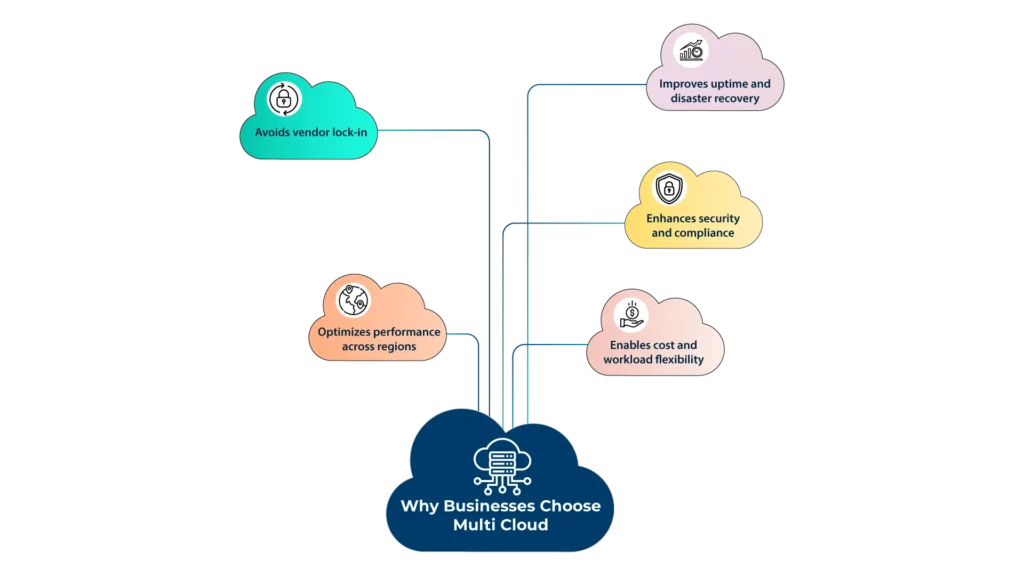
Why Businesses Are Moving Away from a Single Cloud Provider
At the start, depending on just one cloud provider can feel simple and efficient. Over time, however, the drawbacks begin to surface. Rising costs, service limitations, and lack of negotiation flexibility quickly become real concerns.
The biggest risk of all is vendor lock in, where migrating away from one cloud becomes expensive, slow, and operationally risky.
“I’ve seen how difficult it becomes to switch when every application, dataset, and workflow is deeply tied to one vendor. That’s when companies truly understand the hidden cost of early convenience.”
A strong multi cloud strategy helps businesses avoid vendor lock in while maintaining long-term control over their cloud decisions.
Multi Cloud vs Hybrid Cloud: Understanding the Difference
Although the terms are often used together, they represent different models.
Hybrid Cloud
A hybrid cloud connects public cloud infrastructure with a private cloud environment, allowing sensitive data to remain on private systems while scalable workloads run on the public cloud.
Multi Cloud
A multi cloud approach involves using multiple public cloud providers at the same time. Many organizations today operate with both models together as part of a combined multicloud and hybrid cloud strategy.
Why Multi Cloud Is the Smarter Choice Today
The rapid rise of multiple cloud environments adoption is driven by practical business needs rather than trends. Organizations today require flexibility, uptime, performance, and global reach.
Key Benefits of Multi Cloud Hosting
- Reduced dependency on a single provider
- Strong protection against vendor lock in
- Improved uptime and disaster recovery
- Better security and regulatory alignment
- Optimized performance and global scalability
“The true value of multi cloud lies in freedom – the freedom to choose the right tools without being boxed into one ecosystem.”
A centralized Cloud Management Platform (CMP) enables comprehensive visibility into resources, performance, and costs across different clouds.
The Role of Cloud Providers in a Multi Cloud Strategy
Every cloud provider offers unique strengths. Some cloud platforms lead in artificial intelligence. Others dominate scalability, security tooling, or enterprise integration. By leveraging different cloud providers, businesses build technology stacks that are stronger and more balanced across use cases.
This strategic separation of workloads forms the backbone of modern multi cloud architecture.
Popular Cloud Service Providers Used in Multi Cloud Environments
Most large-scale multi cloud environments today rely on a combination of:
Google Cloud
Microsoft Azure
AWS
On-premise or private cloud infrastructure
This mix strengthens business continuity, improves performance flexibility, and reduces dependency risks. A multicloud deployment can leverage multiple IaaS (infrastructure-as-a-service) vendors, or it could use a different vendor for IaaS, PaaS (platform-as-a-service), and SaaS (software-as-a-service) services.
How Multi Cloud Helps Avoid Vendor Lock In
Vendor lock in occurs when a company becomes so deeply embedded into one provider’s tools, APIs, and pricing model that leaving becomes difficult. A carefully planned multicloud strategy reduces this risk by ensuring that no single provider controls the entire infrastructure.
This approach allows businesses to shift workloads freely as pricing, performance, and business needs evolve.
Understanding Multi Cloud Architecture
Multi cloud architecture defines how services, applications, and storage are distributed across multiple cloud platforms and environments. It enables high availability, workload portability, optimized performance placement, and consistent governance across clouds.
When designed correctly, this architecture improves both technical resilience and business agility.
What Are Multi Cloud Services?
Multi cloud services help organizations operate efficiently across multiple environments. These services include cloud cost tracking, performance monitoring, security enforcement, governance, and automated scaling.
Together, they simplify multicloud management and make daily operations far more predictable.
Why Multicloud Management Platforms Matter
Managing multiple clouds manually increases complexity and operational risk. A multicloud management platform centralizes cloud visibility and control across all environments.
It enables:
- Unified monitoring
- Policy enforcement
- Cost optimization
- Security tracking
- Performance management
With the right platform, teams gain full control over every layer of their multi cloud infrastructure.
Cloud Management Is the Backbone of Multi Cloud Success
Without strong cloud management, even the best multi cloud strategy can fail. Costs rise silently, security gaps emerge, and operational chaos sets in.
A centralized cloud management platform ensures consistent visibility, cost discipline, and security governance across all cloud environments.
A Real-World Cloud Vendors Example
Consider a global e-commerce company operating at scale. It uses:
Google Cloud for data analytics
Microsoft Azure for application hosting
A private cloud for sensitive financial data
AWS is known for its robust storage solutions, Microsoft Azure for its integration with Microsoft enterprise tools, and Google Cloud for advanced machine learning and analytics. Choosing the right cloud mix involves comparing the features and services offered by different cloud providers.
If one cloud experiences downtime, workloads shift seamlessly to another environment. This built-in disaster recovery capability ensures consistent uptime and protects user trust. This is the true advantage of multi cloud deployments.
Is MultiCloud Trusted?
MultiCloud and other multicloud management tools are widely trusted by enterprises across industries. Their reliability depends on security certifications, compliance frameworks, uptime performance, and customer trust.
When implemented correctly, these platforms reduce security risks and help prevent Unauthorised data loss.
Security Challenges in Multi Cloud platform
While multi cloud increases flexibility, it also expands the security surface. Each cloud introduces new access points, configurations, and threats.
This makes consistent security policies across multicloud environments absolutely essential. Security must be unified, not fragmented across platforms.
Multi Cloud and Regulatory Compliance
Many industries operate under strict regional compliance laws. A strong multi cloud approach allows businesses to host workloads across compliant geographies using the most suitable cloud providers for each regulation type.
This flexibility is especially critical in finance, healthcare, and government sectors.
Hybrid Cloud Deployments Within Multi Cloud Strategies
Most enterprises operate hybrid cloud deployments inside broader multicloud strategies. Sensitive data remains within private infrastructure, while scalable digital workloads run on public clouds.
This hybrid approach delivers agility without sacrificing control.
Cloud Native Application Technologies and Multi Cloud
Modern applications rely on cloud native application technologies such as containers, microservices, APIs, and serverless computing. These technologies are designed to run consistently across multi cloud environments, making workload portability smoother and faster.
How Multi Cloud Helps Optimize Performance
Performance improves when workloads are placed strategically across different cloud platforms. High-performance compute runs close to users. Cost-effective storage is placed in optimized regions. Analytics workloads run near data.
This smart placement helps businesses continuously optimize performance across their cloud architecture. Multi-cloud offers businesses flexibility, cost optimization, better performance, and disaster recovery by leveraging unique strengths of each platform.
Multiple Cloud and Disaster Recovery
Disaster recovery is strongest when designed across different cloud service providers. If one zone fails, failover mechanisms activate on another provider, ensuring continuity without customer disruption. To achieve disaster recovery, robust backup and recovery plans must span across multiple providers to ensure business continuity.
Data Storage in Multi Cloud Computing Environment
In multi cloud environments, data storage is distributed across platforms to improve redundancy, compliance, and availability. This distribution significantly lowers the risk of total data loss.
Cloud Services and Business Flexibility
Modern cloud services span compute, databases, AI tools, DevOps platforms, and security services. By combining different cloud services from multiple cloud service providers, businesses gain unmatched agility and scalability. Multicloud enables organizations to comply with region-specific compliance rules by switching between on-premises, private, and public landscapes from different vendors.
How Many Cloud Infrastructure Should a Business Use?
There is no universal answer. Some organizations operate efficiently with two clouds, while others use three or more. What matters most is ensuring that one cloud provider never controls the entire environment.
Industries That Benefit Most from MultiCloud Infrastructure
Multi cloud delivers value across almost every sector, including retail, healthcare, fintech, SaaS, media, and manufacturing. Wherever uptime, compliance, and scalability matter, multi cloud becomes the preferred model with better security and compliance.
Multi-Cloud and Business Continuity
Business continuity depends on operational independence. A failure in one cloud should never interrupt customer experiences or revenue flow. This is why organizations increasingly rely on multiple vendors.
Common Mistakes in Multi Cloud Adoption
Many companies rush into multi cloud adoption without sufficient planning. Common mistakes include fragmented governance, weak cost controls, inconsistent security frameworks, and poor cloud visibility. Setting up a multicloud infrastructure is a complex process requiring advanced technical expertise, which many organizations may lack in-house. Ensuring data privacy and security becomes a massive challenge when data is shared with multiple cloud providers due to differing security policies.
A structured, well-managed multi cloud approach avoids these risks and strengthens the security measures.
The Future of MultiCloud Environments
The future of cloud is multi cloud by default. Organizations will continue expanding across regions to access faster compute resources, improve latency, and deliver better customer experiences. Multicloud strategies will be shaped by AI workloads, Zero Trust security models, unified governance, automation-first operations, and intelligent cost optimization.
Centralized CMP platforms will become mandatory as complexity grows. Multi cloud will no longer be viewed as a technical setup alone – it will be the foundation of enterprise agility and resilience.
Final Thoughts: Why Multi Cloud Is the New Standard
Multi cloud is no longer optional. It is now the foundation of modern cloud computing.
It enables organizations to avoid vendor lock in, strengthen security, improve resilience, and scale innovation without limits.
“For me, multi cloud is not just a technical model. It’s a long-term mindset built on choice, balance, and control.”
Simplifying Multi Cloud with Cloudeva.ai
As multi cloud environments continue to grow in scale and complexity, having a single, intelligent layer to manage distributed compute resources across different providers becomes essential. Cloudeva.ai is an AI-first multi-cloud management platform that delivers unified visibility, AI-native automation, and conversational cloud operations through one powerful interface.
With AI-driven FinOps for cost optimization, enhanced SecOps for security monitoring, predictive insights, and an agentic AI roadmap for autonomous cloud operations, Cloudeva helps IT, FinOps, and SecOps teams manage, optimizing costs, and secure their multi cloud infrastructure with clarity and confidence.